Latest Tweet

Saturday, 23 July 2011

Wassertürme

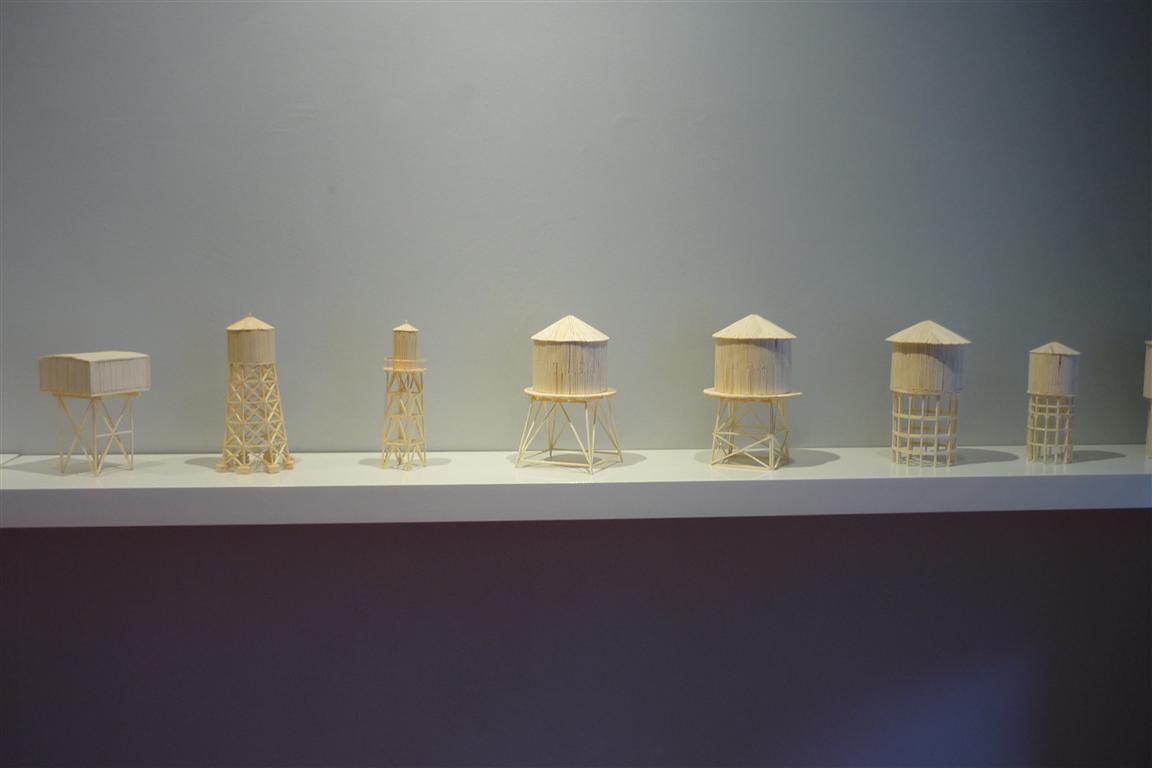
This is brilliant - Tim Taylor is building scale matchstick models of all the water towers illustrated in the Hilla and Bernd Becher's book "Wassertürme"! This fantastic book covers water towers in Europe and the U.K. and some from America too. The towers are being built at precisely the size they appear in the Becher's plates, within the book. Hence they are not actually in scale with each other, but are all of a similar size. Tim is transforming their photographical record of the water towers into his own reality, so to speak. Wassertürme is also available in English (ISBN 026202277X) it was dubbed the "Old Testament" at the last BWTAS meeting (Barry Barton's book being the "New Testament").

The exhibition is on now and runs until 29th July, and is on at 36 St. Mary's Street, Edinburgh, EH1 1SX. Details can be found here. A sample of Tim's towers are presented below...

Saturday, 2 July 2011

Ormskirk water tower owner seeks information, offers access...


image lifted from http://www.uniquepropertyblog.co.uk 
Last Thursday, Mike Jones and his friend became the proud owners of the Ormskirk Hospital water tower in West Lancashire.


Now Mike is asking if BWTAS members know anything of its history. All he knows is that it was built in 1860 to provide water to the Poor Law workhouse that then became Ormskirk Hospital in the 1950's.


Mike's taken up the standing offer of complimentary membership of BWTAS to tower owners and he would be happy for members to come and look around before they start conversion although he and BWTAS can't accept any liability for injury etc. In today's litigation culture we are compelled to say that.


Mike's also looking for guidance from any qualified members whilst he plans what to do with this fantastic building.


Please contact him on mjhousebuild@tesco.net or mobile 07751 605384. The tower is off Nightingale Walk, postcode L39 2AZ.


Prior to the sale, Burcough-based property specialists Armistead Barnett were saying they expected the demand for this property to be high.


Sales manager David Cowburn told the Ormskirk Advertiser: “This is an iconic, landmark building which offers a fantastic opportunity for those looking to create their dream home. The Water Tower is of particular architectural interest due to its five storeys, side projectile pipes, arched windows and the large water tank on top. Planning permission has been granted for two flats but there is potential to create one huge five-storey residence. It will make for a stunning home.”


The 175 square meter tower was part of the hospital site purchased and developed by Persimmon Homes as Nightingale Walk.


Nearby residents aslo said they were in favour of the developement. Neil Wynne, of Pinfold Road, said: "I would prefer it if someone moved into the water tower."


Ormskirk is also known for another water tower, the concrete 'UFO' at Scarth Hill to the east of Ormskirk. 


Sadly there is also a very large derelict one at Greetby Hill, now obviously a missed development opportunity but in its dotage has become reminicsent of a Victorian folly. An application to convert it into seven apartments in 2001 was later withdrawn. Greetby Now  and Then.


Thursday, 30 June 2011

The ultimate project?: Cold War water tower up for sale


When Southern Water unloaded a portfolio of properties in 2004, architect Stephen Luxford purchased the Braithwaite water tower at the former Greenham Common airbase and then got planning permission to convert it into a house. That was a bit of a shock to the local council as they expected buyers would cut it up for scrap and put a traditional house on the plot.

We haven't heard anything for a while but Stephen has just been in touch to tell BWTAS:

"I’ve had the planning extended to 2013 and due to my business being London based, I have given up on carrying the scheme forward myself and the tower is going to auction on 27th July 2011 with www.romans.co.uk – guide price £50,000. "

Stephen told BWTAS before that a build cost estimate is tricky because of unusual nature of the build but at £1200 to £1500/m.sq (quite a high rate) it would be in the region of £160k to £200k.
The auction listing is at http://www.romans.co.uk/Property/40980


Water tower gets robo-clean


First Water Tower Robot Clean for Panton McLeod


29th June 2011


Water quality engineering firm Panton McLeod has completed another first in its work within the UK’s water sector after cleaning a storage tower with robotic technology.


The firm used its VR600 cleaning robot to clean the interior of a water tower in Wiltshire for Wessex Water while it was still active and in service, ensuring minimal disruption for customers in the region.

The project at Minety Tower near Wootton Basset represented the first time that Panton McLeod has ever used the innovative machine to clean an elevated water storage structure in the UK.
In order to access the facility, the firm had to hire a crane in order to lift the robot to the top of the 35 meters high tower before disinfecting the machine and lowering it into the structure.


A team of operators then manoeuvred the remotely-controlled machine throughout the interior of the structure – in order to remove any build up of natural materials on the floor of the facility. The routine work ensures that the drinking water stored in the tower remains at the highest quality levels.


Paul Henderson, operations director at Panton McLeod, said: “We regularly use the VR600 machine for cleaning service reservoirs and storage tanks across the UK. In recent years, the machine has been a vital part of our work for some of the biggest companies in the water sector, including Scottish Water and Severn Trent Water.

“However, before the project at Minety Tower, we had never used the robot to clean a water tower. It represented a big challenge for our underwater team, but we were able to use our expertise to ensure that the project was a success.


“The most challenging aspect was lifting the robot to the top of the 35 metres tall tower in the first place, so we could insert it into the facility and start the cleaning process. We had to hire a special 55 tonne crane to hoist it to the top, but once this was complete, the rest of the project was fairly straight forward.


“We’re delighted with how smoothly the whole cleaning process was carried out, and proud of our team who ensured that this challenging job was completed swiftly. We’re always happy when we identify new ways to deploy our technology, and we hope that this project will lead to more water tower cleans in the future.”


The VR600 is a special tracked robot that is manoeuvred along the floor of any water storage structure and removes any sediment build up on the floor of the structure. It can also be used to inspect the condition of the water tanks, including checking the walls and interior of the facilities for corrosion or damage.

Panton McLeod also uses a specialist ROV inspection robot which is manoeuvred like a submarine through the water in a service reservoir and is able to inspect the walls of the tank, joints, and the roof soffit for damage or leakage.

Both machines are remotely operated from the surface and fitted with cameras and lighting equipment, allowing staff controlling the sub to assess the interior of the tanks. They are also used solely within clean potable water environments and meticulously cleaned and disinfected prior to every use to ensure they can be safely used in the public water supply, and Panton McLeod conducts rigorous tests before and after each inspection.

More information about the machines and Panton McLeod’s other services for the UK water sector can be found at their
website

--


You can see the VR600 in action on YouTube


Water tower tanks are traditionally cleaned and serviced by taking them offline, draining them and then sending workers into the tank via the access hatches to sweep and flush the built-up sediment down the overflow/waste line by hand. Sometimes a small rowboat was lowered inside for inspections. We suppose the health and safety regulations now make the cost of cranes to lift robot vacuums (basically high-tech pool cleaners) into the tank a cheaper option.


Monday, 27 June 2011

East Anglia's water tower history


Water tower development is driven as much by social reforms as the progress in civil engineering and it is also driven by improvements in the technology of building materials, pumping machinery, steam engines and pipe making.


From their aqueducts the Romans used bucket-chain pumps powered by animals and slaves to fill raised cisterns with clay or wooden pipes for local water distribution. The foundations of Roman water towers have been discovered at Ixworth and in the City of London. At Vindolanda in Northumberland, wooden pipes over 2000 years old were found still working. 


Many Medieval castles and monasteries had stone towers lined with clay or lead as a strategic supply. Lendal Tower in York was once a water tower. Though many castles - like Chester - have a tower called 'The Water Tower', this is misleading. It is because they are gates accessible by water.


Wind and water driven pumps began to appear in the late 16th century. A ‘forcer’ pumping water “to the highest parts of the city” was recorded in Norwich in 1583.


One of the great early water engineers was George Sorocold (1668 - 1717) of Derby who also built water systems for Norwich, Bristol, Leeds and London but we know very little about his life. 


Many landscape artists painted the York Street water tower of 18th Century London which was pumped by a paddle wheel in the Thames.


The Industrial Revolution (1760- 1830) brought a huge demand for water and advances in iron and steel manufacturing. Water towers became landmarks alongside engine houses, chimneys and factories in our towns and cities.


Water towers present many engineering challenges. The search for affordable materials and methods that can resist the relentless force of gravity acting on water has stimulated progress to this day.


Ferro-concrete was  first invented for building water towers by the French engineer Francois Hennebique in 1892.


Water tower styles reflect the architectural movements of their time. Horstead in Norfolk was a bold experiment in 60’s modernism because its designer thought the planners and local people wouldn't want to see "another baked-bean tin on legs". The earliest of many concrete towers in Suffolk built between 1930 to 1950 by the Vibrated Concrete Company have ornamentation reflecting the new streamlining seen on ships and locomotives. Later towers, keeping to the same basic layout, have ornamentation of a more angular pattern. Plotting the dates of construction reveals that hints of Art Deco morph into touches of Bauhaus and the angular singularity of Le Corbusier.


According to English Heritage; at one time the "the water industry in England was of the greatest international importance ... many of the solutions adopted in Europe and North America were first devised in English towns."


After a fire destroyed Hamburg in 1842 because the water supply had failed, the Kaiser of the day had British engineer William Lindley (1808-1900) built several towers for the new water system. Lindley went on to work for many other European cities. A street in Budapest commemorates him. The attractive water tower in Epping High Road is his work.


The cholera epidemics of the mid 19th century and the ‘Great Stink’ of London in 1858 convinced Parliament that Britain’s water supply needed a complete overhaul. Victorian engineers like Joseph Bazalgette (1819 - 1891) built large metropolitan water systems and many water towers. Meanwhile, a rapidly expanding railway network with its need for a water tower every ten miles for steam locomotives; spurred the development of large-scale metal pre-fabrication which then lead to advances in bridge and building construction.


This period up until 1930 is considered the golden age of water towers. Worldwide demand encouraged research and development as British civil engineers got plenty of orders for successful designs from Shanghai to Sudan.


Despite progress in the cities, waterborne diseases were still common in rural areas where local governments could not raise the capital investment required to prevent the pollution of boreholes or rivers supplying the community from the effluent of domestic cesspits.


Some remarkable water towers were built by landowners, schools and asylums but in 1910, two thirds of rural parishes in England still had no piped water. 


In 1944 the rural water boards obtained by an act of parliament the public investment they needed for a long period of post-war tower building but in some towns, people campaigned to stay 'dry' rather than have any increase in their rates.


During the Second World War, East Anglia’s strategic position caused a great number of prefabricated steel towers to be built for military installations, most commonly the Braithwaite system of bolted panels still made today, but there are others. Afterwards some were adopted for the public supply and remain in use but it took until the mid-sixties to connect every town and village in East Anglia to mains water. 


The future of water towers in East Anglia likely lies in their imaginative reuse. 


Opinion can vary widely if they are assets or blights to the skyline. Their visibility does give them commercial value while some styles can present challenges to convert for occupation but few people can resist an offer to see the view from the top of one and they are eagerly sought out by people looking for a restoration challenge or unique homes.


Disused towers have become homes, offices, performance venues, sports facilities and tourist attractions but their potential has yet to be fully exploited.


© Nat Bocking

Monday, 30 May 2011

Take a little, give a little more back


Water tower hunters are incredibly grateful for the modern tools of online maps and user-contributed maps available today. In the old days, desk-based research consisted of painstakingly poring over paper maps grid square by grid square, noting any instance of 'wr twr' with the certain knowledge that many towers that were marked therein didn't exist any more and many more towers stood majestically but entirely unmarked.


The reasons for this are varied; sometimes they were simply misclassified or missed by the cartographer when the photo survey took place. Or their omission was for reasons of security of the public water supply or that their presence indicated activity which someone would prefer the public knew as little about as possible. Besides their appreciation, unimpeded access to accurate data on water towers has been the raison d'être of BWTAS.


To find towers in the first place, there is now a dizzying array of resources such as Geograph, Flickr and Panoramio that enable people to post for example their travel photos and pin them to a map with exact coordinates. These sites have thousands, perhaps millions, of water towers images as they never seem to fail to attract attention of photographers however, there is the drawback that such user-generated content does vary in quality.


The iconic water tower in Thorpeness, Suffolk known as 'The House in the Clouds' is variously marked up to a quarter mile from its actual location and by many names such as 'The House in the Sky' and, though a minor detail, it is often described as a converted tower when it was purpose-built to be a home that happened to have a huge tank on top. Such mis-information then gets parroted by other web-hunters and also makes its way into printed tourist guides and becomes a 'meme' that is impossible to correct.

What's still missing from the web though is some way of recording all the other 'meta' data about a water tower along with its location and images of it from various viewpoints. BWTAS are not aware yet of a resource - except for Britain's listed structures - that allows recording of all the pertinent details of British towers that could be searchable by form, date of construction, materials, designer, owner and so on along with its location coordinates and images. It would be very handy to have something that could hold all the various kinds of water tower data, from addresses to the ISBNs and reference numbers of sources. If you know of such a tool, please comment or get in touch as many people in the water tower fraternity think Britain's water infrastructure deserves an online database like the Defence of Britain Project.


In the meantime, the BWTAS committee would like to encourage our members and the world at large to show gratitude for the availability of these free resources and so when we take a little, to give a bit more back by contributing to what's out there. As there are so many resources, a bit of discrimination should be considered as to what is worthwhile to support. In the UK the site Geograph has a 'critical mass' of water towers and so new towers should be added there as it is quickly becoming a definitive list.


If you know of a water tower-related museum, heritage site or a water tower open to the public, it would be helpful to get it listed under 'attractions' in the databases Sat Nav manufacturers pre-install such as the Tele Atlas GPS POI database. POI databases are becoming more and more important all the time and have become the de-facto Yellow Pages ® while people are on the move.


The process is easy, just point your browser to the multi-language Tele Atlas Map Feedback web site and follow the 3 easy steps to somewhere listed or have an incorrect listing changed. This site allows you to enter a location by coordinates or post code but the coding of the point of interest for a water tower is limited to 'other'. One drawback on this site is that it doesn't provide much evidence for locating the precise location. You can drop a pin anywhere on the map but it's best to already have the location coordinates written down before you use the site to enter them.


While you’re adding a heritage site to Tele Atlas you can also add it to the NAVTEQ POI Database too. This site has a lot more detail and the maps can switch between satellite images and graphics so you can be sure you are pinning the right place. At the time of writing only one water tower at King Faisal St, Al Foutah, Riyadh, Saudi Arabia was listed there.


And, if your community is plagued by HGVs getting stuck in narrow lanes because of reliance on the driver's sat nav, (which is common issue vexing parish councils in Suffolk) then you can record the actual road restrictions on the NAVTEQ site as well, which should re-direct inappropriate traffic away in the future.


Although you are basically working for free for entity who are profiting from your effort, if you have a vested interest in water towers in some way, then it's well worth the trouble to let other people know exactly where these points of interest are.


For more esoteric data, perhaps purely to record the existence of a structure which the OS Map has omitted, an extremely useful resource is OpenStreetMap, a free editable map of the whole world. It allows you to view, edit and use geographical data in a collaborative way from anywhere on Earth. This site is hosted in London at the UCL VR Centre for the Built Environment.


Here is an incredibly nifty video showing how quickly mapping of the Earth has been done by crowd-sourcing since the project began in 2004.


OSM 2008: A Year of Edits from ItoWorld on Vimeo.


At the time of writing this there were only fifty or so towers marked on the Open Street Map, mostly in the USA. Whilst the learning curve to be a map contributor here is steep, it is a short hill. Most importantly, this resource has enormous credibility and is being used in developing countries and by governments to assist all manner of planning and development which mapping for would otherwise be impossible and unaffordable. Just as the reigns of power were snatched from his hands, erstwhile prime-minister Gordon Brown released the British Ordnance Survey base map to OSM to enable the mapping of the United Kingdom.


Water tower fans should be contributing OSM because people are able to use the data in print publications and websites for free whereas it typically costs £50 to license OS data in a small leaflet or website. So for a body wanting to publish a pamphlet of a local heritage trail, that cost, in practise, rather impeded such initiatives.

Friday, 27 May 2011

Tell me, where do you come from my Cotton Eyed To (wer)?


In 1915, when its population was about 1600, the city of Cotton Plant Arkansas USA was the birthplace of one of the greatest ever Americans, Sister Rosetta Tharpe.

A fine documentary recently shown on the BBC about Sister Rosetta opens with views of the water tower, bearing the proud name "CITY OF COTTON PLANT". It's a fairly ordinary water tower and it never supplied water to the home of this great American artist.

It turns out that the present steel water tower was built with funds from the PWA (Public Works Administration, an agency of Roosevelt's New Deal) in 1935. It replaced an earlier water tower which would have been serving the city at the time Sister Rosetta was born.

At the age of six she was taken by her evangelist mother Katie Bell to Chicago to join Roberts Temple, Church of God in Christ, where she developed her distinctive style of singing and guitar playing. 

At the age of 23 she left the church and went to New York to join the world of show business, signing with Decca Records. For the following 30 years she performed extensively to packed houses in the USA and subsequently Europe, before her death in 1973.

In 2008 the state governor of Pennsylvania declared that henceforth January 11th will be Sister Rosetta Tharpe Day in recognition of her remarkable musical legacy.


The present Cotton Plant water tower - beside the town's derelict one room jail - is being nominated to the National Register of Historic Places with local significance under Criterion C as a good example of a 1930s water tower. The Cotton Plant Water Tower is also being nominated to the National Register under Criterion A for its associations with the activities of the PWA in Woodruff County during the 1930s. The Cotton Plant Water Tower is being submitted to the National Register of Historic Places under the multiple-property listing “An Ambition to Be Preferred: New Deal Recovery Efforts and Architecture in Arkansas, 1933-1943.


Sanborn Fire Insurance Company noted in its first map of Cotton Plant that the small, eastern Arkansas city had a four inch main running a short distance along Main Street. This water main served eight one inch hydrants used solely for sprinkling the unpaved street. One water tower, sixty-three feet above ground, held 23,000 gallons of water to help keep the dust to a minimum in this quickly growing town. This first water tower was behind a blacksmith shop north of Main Street and west of Ammon Street in the middle of the block. Though the population, 900 in 1908, reached 1,661 by 1920, the city continued to maintain this simple water system and 23,000 gallon tank. More information from Arkansas Historic Preservation Program


Cotton Plant was first called Richmond and was sparsely settled as early as 1840. William Lynch was the first man to build a store in the area, settling here from Mississippi in 1846. After unsuccessfully seeking application for a post office by the name of Richmond, the town settled on Cotton Plant in 1852. Lynch’s store attracted others and soon the village became the center of economic activity in this relatively isolated part of Woodruff County. It was not until 1887 that the town was formally incorporated.

Thursday, 26 May 2011

Everyone comes to Ric's

Dining at Ric's Grill in Lethbridge, Alberta is truly an extravagant experience; located 150 feet in the air in a converted watertower, Ric's Grill guarantees a dining experience that is so unique, it is the only one of its kind in all of North America. 


From the Daily Commercial News and Construction Record:


Lethbridge, Alberta builder spends $2 million to turn water tank into restaurant

PAT BRENNAN, correspondent, LETHBRIDGE, Alta.

Builder Doug Bergen always marvelled at his town’s water tower while growing up in Lethbridge, Alta. It was the tallest structure out on the wide open prairies south of Calgary. So, he was shocked when he learned Lethbridge proposed to scrap the retired water tower.

Bergen, an architectural technician and developer, persuaded the town to sell the water tower to him and more than $2 million later he opened it as one of Canada’s most unconventional restaurants.

He believes it is the only restaurant in the world built into a water tower 12 storeys above the ground. “The town council fought me all the way on this project. They made me jump through some very unreasonable hoops, but on our opening night in 2004 the entire council was there for the free booze and food,” said Bergen.

City engineers claim the tower, built in 1958, had outlived its usefulness and it sat abandoned for several years after a new community reservoir replaced it. “The town’s public works feared it was unstable and should come down, but I had consulting engineers check it out and found it was still strong and sturdy. The municipal guys wouldn’t even climb up the tower’s ladder to check inside the tank,” said 44-year-old Bergen.

“It’s been an iconic structure in Lethbridge and southern Alberta and if I was going to keep it alive I wanted to make it a place that the public could visit and use.”

It took him two years to find a tenant, but eventually Ric’s Grill, a chain of nine steak and seafood restaurants in Alberta and B.C. moved in and has become a popular tourist attraction in Lethbridge.

Bergen designed the 9,000-square-foot restaurant with two levels for eating and a third as a lounge in the bulbous water tank, which used to hold 500,000 gallons of water 36 feet deep. He had to hoist nearly 1,700 tons of washed gravel into the water tank to replace the weight of the water to keep the tank from swaying in the prairie winds.

He cut 32 windows into the side of the tank, plus skylights in the top. A catwalk was built around the outside of the tank so maintenance crews can wash the windows. An elevator was installed in the 8-foot-diameter central shaft of the tower to carry customers up to the restaurant. Eight narrower legs support the weight of the tower. Bergen added large banners between each of the legs, which he rents out as billboards.

A 60-foot-tall transmission aerial was added to the top of the water tower.

Everything but the customers and the Alberta beef steaks had to be lifted to the restaurant by mobile cranes. Steel floors were crafted to create the three levels.

Douglas J. Bergen and Associates designs and builds real estate and commercial projects in Southern Alberta, such as vacation cottages in the Crownest Pass in the Rocky Mountains.

Wednesday, 25 May 2011

Save the Sudbury water towers campaign

Mind we are talking Greater Sudbury, Ontario.

When plans were afoot to demolish two iconic water towers known as 'Pearl Street' and 'Pine Street' respectively in Canada's Nickel City, a group of local artists put up an impressive resistance; not by sit-ins and petitions but by mounting exhibitions illustrating the towers' value as cultural objects far beyond their municipal purpose.

Built in 1956, the two towers stayed in use until 1998 when they were decommissioned. Standing tall on sites overlooking the city, the towers turn an otherwise unremarkable cityscape into an interesting panorama.


The present outcome appears to be that the city has voted to remove Pine Street but in 2010 a developer bought Pearl Street and plans to convert it, meantime exploiting its landmark value by erecting 'art boards' (plain speaking: billboards) to raise the revenue to fund this. Many ideas are floating around for turning it into a heritage centre, an art gallery or viewing platform or all three. A feasibility study has been undertaken of various proposals citing the successful redevelopment of other surplus water towers.

This was all started in 2009 by Joel Kimmel, an illustrator originally from Ottawa who became fascinated with water towers on a trip to New York in 2005. He loved them so much that he moved to Brooklyn and roamed the streets beneath the towers for two years. In 2009 he moved to Sudbury where he immediately chose the water towers as his favorite landmarks.

Joel and his chums got 50 other artists and photographers in Sudbury and lovers of water towers from around the world to submit their artwork to be displayed on their website and in an exhibition held in 2010 that raised awareness and showed the City of Greater Sudbury that the people love their towers. Take a look at the blog for some great pictures, then and now.

Whilst the blog hasn't had many updates recently (gosh, we can empathise with that), the very active Facebook group has over 600 members.


Water tower facts:

Pearl Street:
Built by Horton Steel Works Limited, Fort Eriein.
Volume 1,000,000 imperial gallons (3.8million liters- about 17000 bathtubs!)
Height to Underside of Bowl – 76 feet (about 23 meters)
Overall Height - 112 feet (about 34 meters- ? This may be wrong)
Diameter of Bowl – 96 feet (about 29 meters)
Height of Bowl – 36 feet (about 11 meters)
Centre Cylinder – 8 feet diameter
Tower Legs – 4 ft 4 in diameter at 75 ft spacing
330 Tonnes of Steel

Pine Street:

Volume 500,000 imperial gallons (1.9million liters- about 8,400 bathtubs!)
Overall Height- 131ft (about 40 meters)

Sunday, 22 May 2011

Church Langley, Harlow: The 'M11 Water Tower'

Considering the number of times it is mentioned to BWTAS, the editors of this blog have been remiss in telling readers that the Church Langley water tower near Harlow has had its own website for some time.


www.m11watertower.org.uk


Famous for its prominent position next to the M11 motorway and a frequent site for charity abseils, this striking 'bowl in hand' form tower was completed in 1993, making it one of - if not the - last public supply water tower constructed in Britain. 


The site's author is one of the original construction workers and would like to hear any stories about the tower.