Latest Tweet
Monday, 28 January 2013
Mackintosh Harebell Tower
Q. What do Charles Rennie Mackintosh, a harebell and the Glasgow Herald have in common ?
A. (naturally) - a water tower
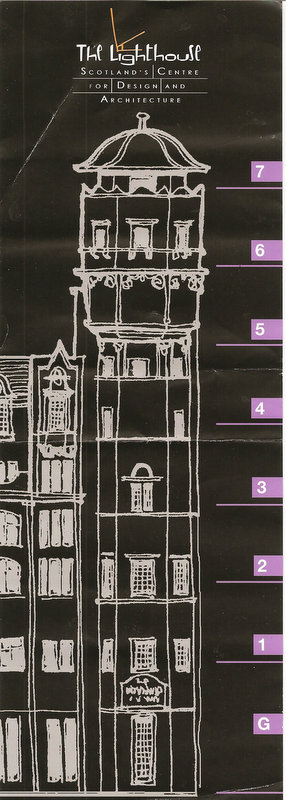
I came across this hidden gem on a brief visit to Glasgow earlier in the week. On the trail of Charles Rennie Mackintosh, I visited the Mackintosh Centre in a building called the Lighthouse. Hidden down a passageway off bustling Buchanan Street, totally surrounded by tall buildings and a multi storey car park , the building once was the factory where the 'Glasgow Herald' was produced . It has a water tower rising 3 storeys above the 4 storey factory, part of the original CRM design. It's possible to climb up the tower via a magnificent internal helical staircase and go out on to a small viewing gallery.
Its very difficult to photograph and short of a helicopter , its only feasible to do so via a viewing gallery in a separate part of the building (thankfully accessible by lift!). But pics have to be taken through glass and don't give the best view of the tower. In particular, the view of the cupola does not show off Mackintosh's harebell design properly.
A hidden , and interesting, tower with lots to discover in the rest of the building too.
We hope David didn't have to 'cough up' very much to see the harebell... (sorry)
Saturday, 26 January 2013
Water towers in broadcasting
There are reminiscences of historic outside broadcasts at the website of the Alexandra Palace Television Society.
Thursday, 24 January 2013
Saturday Live - Jumbo Edition
The show's format is "extraordinary stories and remarkable people" and is presented by Sian Williams and The Reverend Richard Coles.
I don't profess to be the latter but there are many extraordinary stories about water towers and Jumbo's story arc is perhaps typical of them all. An engineering marvel, an object of immense civic pride and a symbol of mankind's triumph over nature; it and the people behind it are forgotten and a safe reliable water supply is taken for granted by the public yet within a lifetime ago things were very different.
![]() |
| Babylon in D W Griffith's 1916 'Intolerance' |
I hope that will make the area a bit more attractive, as it once was, although the future of Jumbo is still very uncertain. It has turned out to be a white elephant for the developer who bought it. Though there are people with well prepared plans that could put it to good use for the benefit of Colchester, and have been trying to do so for years, that non-profit body can't raise what the developer paid for it in the heat of the bidding.
![]() |
© Balkerne Tower Trust
|
In the intro and outro, the reverend mentioned the water tower in his parish at Finedon near Peterborough as a companion to his church. I must agree it is rather a fine 'un.
Saturday, 5 January 2013
Settling In
A brand new follow-up episode of the Settle water tower restoration is to be shown on Thursday 31st January 2013 - 9pm to 10pm on Channel 4 'Restoration Man'
The programme shows the project 'one year on' and reveals a fascinating new historical discovery.
Thursday, 29 November 2012
Ormskirk's Water Towers
A report by Edward J McCarthy:
Ormskirk in West Lancs currently has 3 water towers left but has had others in the past.
The majority were built by Ormskirk Urban District Council, and then this function was served by West Lancashire Water Board, later North West Water, and then United Utilities. West Lancashire Water Board was set up following an Act of Parliament in 1907.
Tower Hill.

Located on Tower Hill in Ormskirk. Locally, Ormskirk is well known for the concrete, mushroom shaped water tower on Scarth Hill. Less well known is this one just off Greetby Hill. The photograph was taken in 1987 when the tower was not quite as derelict as it is now.
It was built in 1853. This water tower became a listed building in 1976.
Some information on it-
Water Tower on Tower Hill II* Water tower. 1853-4. For Ormskirk Local Board of Health; now derelict. Coursed squared sandstone, slate roof (dilapidated). Square plan. Romanesque style. Tall tower with 2 narrow full-height Romanesque arches in each side, all with stepped surrounds and arch-bands, linked by an impost band carried round; plain frieze with carved grotesques at the corners, and very emphatic corbelling in machicolated form, surmounted by a large tank enclosed by what appears to be ashlar walling. Pyramidal roof now lacking most slates. HISTORY: unusual survival of early Local Board waterworks structure. Conspicuous landmark on east side of town.There have been plans to convert it into homes but nothing has been successful yet.
Victoria Tower.
Victoria Tower @ SD 42388 08611, Built in 1897 and demolished in the 1980.
There is still a boundary slab from the building near Nursery Avenue in Ormskirk. There is a photo from 1955 in the Lancashire Lantern: Image Archive.
Ruff Wood Tank.
There was a Braithwaite tank in Ruff Wood on Ruff Lane Ormskirk.
In the woods are the remains of an old quarry. This is all that is left of an important site which provided sandstone to build houses in Ormskirk during the 19th century.
Ruff Wood is located on Ruff Lane/ Vicarage Lane in Ormskirk.
Ormskirk Hospital Water Tower.

Ormskirk Hospital Water Tower is currently being converted into 2 homes. Located on Pinfold Rd Ormskirk where the old hospital buildings are. This was still in use in the 1980’s -90’s. A smaller tank was attached to it but this part is no longer there. The older hospital site was sold to Persimmon Homes and they sold the water tower privately in 2011.

Further photographs taken at this location may be found here. Ormskirk Hospital water tower is featured on Amy Caine's Blog where there is further information and additional photographs.
Scarth Hill.
The original tower known locally as the “pepperpot” was built in 1879. It was demolished in 1974. The new water tower was in use from that time. Pictures of the old and new tower and also inside the Pumping Station that has now been converted into homes, may be found on the wiganworld website!
The reasons why the Ormskirk Water Towers were demolished and the new 1974 tower was built, is detailed in a planning application report submitted to Ormskirk U.D.C. by the West Lancashire Water Board, in March 1973.
Edward McCarthy (West Lancs resident)
Saturday, 10 November 2012
Parish Pumps
Monday, 15 October 2012
Newton le Willows, Merseyside (1904-1979)
Newton le Willows was the world's largest water tower at its construction in 1904 and the second water tower in the UK to be built from reinforced concrete and the first of that kind for public supply.
Designed by Reed & Waring, Consulting Engineers, it was constructed by Cubitts & Co. at a cost of £6,000 for Newton in Makerfield Urban District Council. The tank, supported on a trellis-work of concrete legs, was 72 feet in diameter and 12 foot deep, with the roof 82 feet above the ground (117 feet above its foundation) and had a small central turret. The structure leaked when filled and had to be lined on several occasions. When built, the floor was 5” thick, while the walls tapered from 6” to 5”. An additional 3” of concrete was added to the floor as early as 1940. The tower came into use in 1906, with a steam engine operating a bucket type pump. In 1933 this was replaced by two 64½ horse power Sulzer electrical impeller type pumps that raised water from a 200 foot deep well into the tower. The tower underwent repairs in 1910, 1933 and 1962; it was no longer being used in 1977. Although it was a listed building, North West Water Authority got permission to demolish it largely because it was structurally unsound and would cost something in excess of £50,000 to repair. Located by the M6 motorway, North of Newton le Willows, in Southworth Road Waterworks at Grid Ref. SJ 59900 95675. Capacity 300,000 gallons.
This tower was immortalised by Bernd and Hilla Becher in 1966 – Plate 206 in their book “Wasserturm”. In 1953, a new borehole was constructed about a mile west of the tower with a KSB submersible pump capable of supplying 23,000 gallons per hour direct into the mains was introduced providing an additional supply of approximately 400,000 gallons per day. The Southworth Road Works had a capacity of between 750,000 and 800,000 gallons per day in 1955.
More recollections and photographs of the tower are in the history forum at http://newton-le-willows.com. Recently a local resident has contacted BWTAS asking for more information about the tower. What we know is here or has been linked to but if you know anything about the tower, please get in touch or use the comments.
![]() |
| image courtesy of D Hull |
Wednesday, 26 September 2012
BWTAS AGM report
| photo: Brian Light |
Eighteen or so souls came to the BWTAS 2012 annual general meeting at 7:30 pm on Monday 24th September 2012 at the Charing Cross Centre. There were several members of the public and they must have been impressed as BWTAS acquired three new members from the event.
Wil Harvey gave the chairman's report about our successful events of the previous 2011 - 2012 and outlined the plans for events in 2013, all of which depend on other people than the committee getting involved in organising them. There will be another art show in 2013 as these have been very successful with water tower enthusiasts and the public.
Nat Bocking gave a membership report; the membership is closing fast on reaching 200 (until the paper and digital records are conformed we won't have the exact number) and the minutes of previous AGM were read and accepted. The BWTAS blog has had over 85000 page views to date and this report takes it to 200 posts. BWTAS has had a lot of paper correspondence from potential and current tower owners looking for information, architecture and design students, town planners considering potential developments and TV companies producing home restoration shows and 'Have I Got News For You'.
Andy Norris gave the treasurer's report; BWTAS funds grew modestly but encouragingly thanks to the runaway success of our mug and calendar sales. We have standing orders for their next editions.
The committee of Ferrers Young, Wil Harvey, Nat Bocking, Andy Norris, Brian Light and Clare Johnson stood down as committee members but as there were no nominations or other candidates, all the incumbents were unanimously re-elected for another term.
Wil Harvey - Chairman
Nat Bocking - Secretary
Andy Norris - Treasurer
Ferrers Young - Archives
Brian Light - without portfolio
Clare Johnson - without portfolio
The accounts and correspondence were left open for examination. There was no other business or questions from the floor so the Annual General Meeting was closed at 8PM.
Brian Light of the Balkerne Tower Trust then gave an update on developments at Jumbo.
Prior to the AGM, Ferrers Young - who is also a member of NIAS - had given a very brief but detailed tour of Norwich water history in the immediate vicinity of the meeting which began at the excellent White Lion pub. With that context, he then continued his tour virtually around the water towers of Norfolk. The fascinating lecture was also enlivened by the contributions of Brian Carr, a water tower engineer who had worked on some of the modern towers and provided interesting information that we hope we can post here in time. It is through this kind of dialogue that we can uncover the vast water tower history which is not held in national archives.
A member kindly sent us this review:
...the real star was Ferrers, for choosing the perfect pub to meet in, for showing us all those water-related historical features (pity about the lack of daylight, but great opportunity for him to demonstrate his interplanetary laser pointer), and then for showing us so many water towers in his perfectly-prepared and perfectly-presented lecture. Thanks for giving us such a special evening.
Wednesday, 5 September 2012
AGM & Virtual tour of North Norfolk's water towers
Friday, 15 June 2012
Brooklyn sculpture is fantastic plastic water tower
![]() |
| image from Junk Culture |
The BBC reports a Brooklyn-based artist Tom Fruin has used 1,000 pieces of transparent plastic scavenged from various parts of New York to create a sculpture of a water tower.
The artwork is open to the public and can be seen from the Brooklyn and Manhattan bridges and from parts of lower Manhattan.
It is illuminated by the sun during the day and by Ardunio-controlled light sequences designed by Ryan Holsopple at night. It opened on June 7th and will be in place for one year with a light show beginning at dusk and continuing to morning.
Tom Santorelli reports
Inside the sculptor's workshop: