Latest Tweet

Showing posts with label Railway. Show all posts

Sunday, 3 June 2012

Castlethorpe Troughs Water Tower


There's a nice detailed site on the railway at Castlethorpe and the Wolverton Works near Milton Keynes.  http://www.mkheritage.co.uk/cv/docs/railway/railmain.html 

The London to Birmingham railway was opened in 1838. It passed near to the village of Castlethorpe cutting the outer earthworks of an 11th century castle from which it got its name. Castlethorpe station opened in 1882 and south of it were laid water troughs that steam locomotives on the West Coast Main Line could pass over to refill at speed. A scoop was lowered from the engine and this had to be timed very precisely in fog or in the dark. This stretch appears to have a high incidence of accidents either involving workmen on the track or mechanical failures at speed. Castlethorpe station was closed in 1964 despite protests organised by a prospective Labour MP named Robert Maxwell.
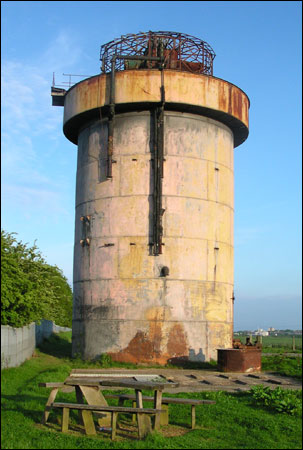


http://www.mkheritage.co.uk/cv/docs/railway/watertower.html
The Gas Works at Wolverton were reponsible for the maintenance of Castlethorpe troughs and its pump. 


crop of copyright image: click through  to view


crop of copyright image: click through to view


Milton Keynes Borough Council provide directions to a walk to all of these sights.


A British Transport film shows the A4 locomotive Sir Nigel Gresley in service as the Elizabethan Express picking up water. Sir Nigel is now preserved.


Friday, 18 May 2012

Eins, Zwei, Dry...


Kerry and Chris Hones are a British couple who possess a trio of extraordinary water towers situated in Nennig on the border of Luxembourg and Germany built around 1870. They found them as a complete ruin and have spent many years renovating them, keeping as many original features as possible, including a shaft into something that looked like a strong room which has become the cat flap. They admit they are nowhere near finished with the project but do what they can when they can.


Nennig sits right in the corner of Luxembourg, Germany and France and the Moselle area is stunning. BWTAS members visiting Luxembourg are invited to come and take a look. Kerry says the wine tasting is to be recommended!


They tell us they have had their share of successes and mistakes along the way but "it is such an individual project we have had to learn as we go." By contacting BWTAS they hope someone will come up with some interesting information about the tower as all the local archives were destroyed in 1945 during WWII. One of the towers looks very similar to the Settle renovation tower though theirs have been added to  over the years and one is now three stories high. Kerry says with justified satisfaction; "It has been a labour of love, immensely hard work and has involved doing many kinds of work I would never of dreamed I could do. He reflects that "too much Kevin McCloud can get you into all sorts of unexpected projects. We have become known locally as the Mad English Couple!"


If you can help, please get in touch with them at khones@pt.lu


Wednesday, 8 February 2012

Settle Station Water Tower Restoration Complete !

The tower taken in today's winter sunshine

The subject of "Restoration Man", Channel 4, 9pm Thursday, 16th February

Mark & Pat Rand, have completed the restoration and conversion of their 1876, grade II listed Water Tower. The project to convert and restore the only surviving water tower on the Settle-Carlisle line has been recorded by Channel 4's, soon to be broadcast, "Restoration Man". But for the full story, visit the Blog: settlestationwatertower.blogspot.com. Now restored to ‘as built’ by the Midland Railway, Mark says "the tower looks as though it could be a new-build, not built in 1876! No re-pointing and minimal pressure washing only in parts". A job well done - they deserve their black book and glass of lemonade on the roof!

The tower before work commenced

Ferrers


Thursday, 23 December 2010

Settle Station Water Tower (1876)

BWTAS members Mark & Pat Rand, have undertaken an exciting project with their recent purchase of the Water Tower at Settle Station, that they intend to restore and convert into a home for themselves. The grade II listed building was built by the Midland Railway in 1876, and is the only surviving water tower on the Settle-Carlisle line, that once had eight water towers. Interestingly, the tower has once before been a home, but for horses: In May 1939, with war threatening, they built four stables inside the tower - we know this because the masons and joiners obligingly left a note - found in a rusty tobacco tin, concealed in a wall behind a newly inserted beam, recording the names of the men who built them. What is exciting about this project is, that as well as converting the tower into a dwelling, Mark and Pat intend to restore it to ‘as built’ by the Midland Railway, with the original colours on each tank panel of (from the middle outwards) Denby Pottery cream, Venetian red and Brunswick green. To assist them, they have a microfiche of the original plans (courtesy of Network Rail) signed by Samuel Waite Johnson in 1874, who was the Midland Railway's locomotive superintendent when the line was opened and approved the tower plans - water towers were the responsibility of the locomotive department. The tower has survived largely intact and is in good condition, however Mark is keen to get in touch with anybody who has experience with this type of tower. A problem which he is currently concerned about, is insulation of the tank base. Presently the tower’s ‘roof’ is made of 1” thick cast iron - just about as prefect a thermal radiator as you could imagine. They plan to insulate it on the outside (i.e. on the floor of the tank) and are wary of condensation below the tank, should they get it wrong. If you can offer any advice regarding this project, please contact Mark at follyatsettle@gmail.com.

Mark has set up a web site: settlestationwatertower.blogspot.com to record the restoration and conversion of this water tower.

The tower is located at SD 818 635 and had a capacity of 43,000 gallons. Click on the photographs above and below for a larger image.


Sunday, 4 October 2009

Huddersfield L&YR Tower regeneration


BWTAS member David Blackburn tells us that this rather unlovely Lancashire and Yorkshire Railway water tower has managed to survive the many changes to the railways over the years and now looks set to become a community and heritage regeneration project.

It stands close to end of the platform at the busy Huddersfield Station and still has its 'plumbing' intact and visible. This large tank was needed to refill tenders before engines faced the steep climb over (and through) the Pennine hills to Manchester.

It is now earmarked to become the base for the Association of Community Rail Partnerships. EU funding has been awarded and details are being finalised with the aim of starting work before the end of 2009 to convert it to an energy efficient office building.

An unusual feature is that the rear wall of the tower is at least twice the height at the back compared to the front, with an entrance from one of the main streets in the town.

It's good to know that another tower appears to have a long term future. This also help ACoRP be more financially secure by lowering their property outgoings and it will make their offices more accessible by public transport.


A local estate agent's website tells us that "Huddersfield was once a mill town. It has a large amount of Victorian architecture having the highest number of listed buildings than any other city or town in the country.

Huddersfield Railway Station is a lovely old building with colonnades. It has been described as a stately home with trains in it. Outside the station is a statue of Huddersfield born former Prime Minister, Harold Wilson."

picture by David Blackburn

Wednesday, 25 March 2009

Merredin Railway, Western Australia (1893)

Merredin came into existence as a result of the goldrush. In 1888, the area to the east of Merredin was officially proclaimed a goldfield and over the next decade prospectors poured through the area and in 1893 the railway reached the town.
The water tower was built in 1893 to store rainwater from the water catchment scheme on Merredin Peak for the locomotives up to 1968. A rock wall was built around the contours of Merredin Peak with a 40 acre catchment area. It led to a 100 m channel that in turn led into a dam that had a storage capacity of 7,474,000 gallons and cost £5366. The scheme collected all the water that landed on the Peak and directed it into the dam, which provided water for both the town and the railway. The tower is 50 feet high and has a square cast iron tank supported by 45 foot timber tower. The water tower was restored in 1997 by the Merredin Historical Society with the aid of a $37,000 grant from the Lotteries Commission.
The need for the water from Merredin Peak disappeared in 1903 when C. Y. O'Connor's 350 mile pipeline was completed to supply water from in the Helena River east of Perth. The Merredin Peak dam continued to supply water to the railway until 1968 and today it is still used as the water supply for the fountain outside the Merredin Railway Museum. Located on the North side of the Great Eastern Highway, National Route 94 at 31º 29’ 0” South, 118º 16’ 45” East, capacity 40,000 gallons.