Latest Tweet

Friday, 30 September 2011

180° of Light show


photo by SteveRSVR
180° of Light is a laser installation linking water towers in Rothwell, Desborough and Corby in the British Midlands with laser beams to form a triangle, the alchemical symbol of water. The project is a part of a county-wide series of site specific artworks on  Northamptonshire's rivers, canals, waterways and water towers. There has already been an installation on Northamptonshire's Oxford canal and there will be a further installation at Sywell Reservoir in October. NESTA fellow Jo Fairfax and FLOW manager Graham Callister came up with the idea. Visible from the A14, the project is part of Igniting Ambition Festival and the London 2012 Cultural Olympiad. The lasers shine from 7.30 to 9.30 pm until 2nd October 2011. Its website gives a raison d'etre:

This site-specific artwork highlights the architectural beauty, science and necessity of water towers in today’s society. Among their many uses, water towers provide pressure to maintain the safety of the water supply, without which water may not spray from a tap with sufficient FLOW.

By using several strikingly bold lasers, this site-specific, large scale installation produces a formal dynamic between the imposing circular drums of the water towers and the stunning, elevated triangle of light which unites them. Dominating the Northamptonshire landscape, 180° of Light encourages conversations both of architectural form and journey.

The artist, Jo Fairfax, described the installations:

“Creating a giant laser triangle hovering in the sky makes me smile. Each water tower forms the corner of the laser triangle creating a conversation in form - the circle of the water drum with the triangle of light. The journey of light is evident and the journey of water is implied, another conversation. The moving striated visual effect created as the laser light breaks down over distance implies a sense of journey. The water tower drum containing water held high, water reader to enter and exit, implies a journey. The two meet either side of the water drum. Both dynamic, one in its speed and break down, the other in its potential and pressure. Water and light, like siblings with a story to tell”.

Key funders included Arts Council England, Legacy Trust UK, Northamptonshire County Council, Anglian Water and Breath of Fresh Air, East Midlands.

More information about FLOW


BBC news slideshow http://www.bbc.co.uk/news/uk-england-northamptonshire-14983682


Here's map of the laser 'field' to aid viewing:


View flow towers in a larger map


BWTAS context:

Illuminating water towers has a long history and was commonplace when water towers were novel and objects of civic pride. The Thorpe Hamlet water tower in Norwich was illuminated for a year to commemorate George V's silver jubilee in 1935. A couple of generations later, illumination of towers was used as way of reasserting their monumental quality and renewing civic pride as part of regeneration schemes. Cranhill Arts Project in Glasgow illuminated their local tower a vibrant green with white spotlights and nearby the Craigend water towers were illuminated as part of Glasgow's reign as the European City of Culture. The city council's lighting strategy webpage asserts: "Good lighting helps to increase vitality and improve ambience. It contributes to a sense of identity and place, makes for a safer, friendlier environment and also supports and complements other regeneration initiatives."

Friday, 23 September 2011

Tower hunting in British Columbia


While on vacation in British Columbia this month I was given a driving tour of the sights of the city of Victoria. When we stopped at Government House intending to eat our sandwiches in its splendid gardens, the cooler we had brought along was empty. The sandwiches had been made but left behind on the kitchen counter; the cook thinking the driver would pack them, the driver thinking the cook had packed them. While we made do with the dessert, my companions asked if there was anything in particular I wanted to stop and look at. A few minutes earlier I had glimpsed a water tower atop a distant hill so I said, if they didn't mind, that I'd like to take a look. "But", I warned them, "towers are shy creatures. If you go looking for them, they tend to run away..." 


After stopping at the marvellous outdoor retailer Mountain Equipment Cooperative, we surmised from our map it must lie in the region of the Craigdarroch Castle so we headed there. Navigating the one-way system we came to the coal mine owner's mansion - scene of a legendary and lengthy family dispute - which is now a museum and walked around outside but were unable to see the tower from this vantage point. "It saw us coming" I told my companions. The 'castle', though imposing, is more a sandstone pastiche of Scottish laird and Disney fairytale but it was impressive that every window, including sash ones, and each door was carved to follow the curve of the turrets, a 'hang the cost' detail but with admission costing $13 pp, I have no doubt their upkeep is expensive.


The mansion is in the area called Rockland which was once Victoria's 'Nob Hill' and now an open-top English bus plys guided tours pointing out the mock-Tudor piles of other migrants who made their fortunes in lumber, furs, coal and construction in this last frontier and bastion of the British Empire. Though we couldn't see it, I suspected the elusive tower must be nearby as we were on a plateau and the tower must have been constructed to serve all these grand homes. We set off down the hill to backtrack to where I had first seen the tower, hoping that then we could then turn around and stalk towards it like a game of Grandmother's Footsteps. 


Perhaps it felt like only playing peek-a-boo with us because as we drove away, we suddenly saw it looming over some houses. It was then a case of my jumping out with a camera to capture a view and try to find a way to walk to its base while my companions waited in the car, as they did not want to enrich the city with a parking fine nor be an accessory to any inadvertent trespass. Besides, a large party would likely scare it off again. It was a process of elimination in going up successive driveways, each tantalisingly appearing to lead to the base, to find the one which its attendants must have used to reach the door.


The tower sits rather dilapidated and unused in the garden of a old mansion which is now apparently a multiple rental/condo. Given that access to the tower must have some easement over the driveway, I ran up to the base to log the tower on my GPS device. We then quickly took our leave to visit one of Victoria's many coffee shops, the boho-style Tooks on Cook we had passed earlier. Here very satisfactory sandwiches and slice of quiche with a salad was not as elusive.


View MEC to tower expedition in a larger map


Tower Location: Laural Lane, Victoria B.C. Canada.
Built: 1908. Decommissioned: 2000 
Height: 33.22 m.
Capacity: 412,330 litres. 


The tower is an unreinforced 25.4 cm. thick concrete cylinder of 6.71 m. inside diameter, 21.34 m. high, supporting a 11.89 m. high water tank of equal diameter. This is a balancing reservoir. The tower can be clearly seen from the ocean and has been used as an navigation aid by small craft.


The 128-foot water tower was built by the famous contractor Henry Kaiser. In 1962, to commemorate the centenary of Victoria, the tower was topped by a 22-foot tall neon flame, which burned for over 25 years.


From Victoria Heritage Foundation


 With Victoria’s population growing rapidly, the city water supply was quickly becoming inadequate, and 1909 saw construction of a 100,000-gallon concrete water tower. This must have seemed unsightly, among the villas and Garry oak meadows at one of the highest points of Rockland, but, along with the Smith Hill Reservoir, it constituted a stop-gap project to supply Victorians with water until the new system at Sooke Lake was built. The area around the water tower was known locally as Observatory Hill.

It featured a large, Queen Anne house called Observatory Villa with a 3-storey tower and a small observatory, which was built by amateur astronomer Oregon Columbus Hastings in 1890 (915 St. Charles Street, demolished). By 1903, the lane leading to the observatory had been officially named Observatory Hill.

Thursday, 22 September 2011

Water tower film wanted by TV programme

UPDATE

This programme will be transmitted on Thursday January 12, 20102 at 9pm on Channel 4.

--

Television programme "The Restoration Man” on Channel 4 are desperately looking for film footage shot between the 1900s-1930s showing  any 19th century Water towers across Britain. Their programme is focussing on the Forge Lane Water Tower in Congleton, Cheshire but notwithstanding finding any film of that, they would like footage that shows the interior of any 19th century water tower with it’s water pump in action etc. 
Forge Lane
Some possible towers could be:

  1. Court Lodge Water Tower. Wrotham, Kent. 
  2. The Round House, Perth, Tayside, 1832 
  3. Everton Water Tower, Liverpool, Merseyside, 1854 
  4. Internally Flanged cast iron tank, Wivenhoe water tower, Essex, 1901 
  5. Flaybrick water tower, Birkenhead, Merseyside, 1865 
  6. Friday Bridge water tower, Wisbech, Cambridgeshire, 1894 
  7. Westgate water tower, Lincoln, 1910 
  8. Lymm water tower, Cheshire.
  9. Horncastle Road Water Tower, Boston, Lincolnshire, 1905 
  10. Hartlepool water towers, Cleveland 
  11. Balkerne Tower, Colchester, Essex, 1882 
  12. Winshill water tower, Burton on Trent, Staffs, 1907 
  13. Rockwell Green water tower, Wellington, Somerset, 1885
If you have any information about film footage please contact:

Jane Elizabeth Higgs
Archive Research
The Restoration Man
Tiger Aspect
0207 544 1649

Saturday, 10 September 2011

The Zandvoort towers

From this...


to This.

During World War II, our water towers were not attacked by enemy action, as we now know, the Luftwaffe used these landmarks as aid to navigation - the Dutch were not so lucky. The elegant, reinforced concrete tower on the left, by architect J. van Poelgeest and dating from 1912, was blown up on 17th September 1943, by the occupying forces.

A new 48 metre high water tower that has a brick façade covering its reinforced concrete structure, was erected between 1949 and 1951 from a design by J. Zietsma. It was originally conceived as a round tower but ended up being an octagonal. The tower with two tanks with a total volume of 209,000 gallons came into service in 1952.

Images of construction of the reinforced concrete tower may be found here. The new tower is located at 52º 22' 13" North, 4º 31' 30" East, the old tower was located about ¼ mile to the North.

Any body who has more information on these towers, please leave a comment.


Ferrers

Tuesday, 23 August 2011

Elveden Visit

update 2/9/2011: visit now fully booked

Lord Iveagh has kindly granted permission for BWTAS to visit the Elveden Water Tower, a Grade II listed structure from 1895 and one of the most ornate and imposing examples of a Victorian estate tower in the UK.

Wednesday 12th October, 11.00am. Meet at the Estate Offices, London Rd, Elveden, Thetford IP24 3TQ.


Anyone planning to attend MUST let Wil Harvey know before on 01502 478248 or harveys@care4free.net ASAP, as the estate must have names beforehand. There will be no admission otherwise.

Booking priority is given to BWTAS members, then to the public. Space is very limited. We'll announce any changes and further information here and on twitter @bwtas. Non-members can join the society on the day.

Please note all the usual disclaimers apply: this is a industrial building not normally open to the public, it is not suitable for young children, there is no disabled access and the visit is at the visitor's own risk and subject to the directions of the Elveden estate.


For companions not interested in water towers, there is a shop and restaurant on the estate www.elveden.com

Monday, 8 August 2011

Park Hill, Croydon (1867) - Update


Further to my comments on Croydon Water Tower, I have found additional information regarding this tower, from a copy of “Engineering” 5th June, 1868. The etching above (click picture for a larger image) comes from Google eBooks and is accompanied by the following text on page 545, that I have transcribed here, as it is a little difficult to read:

Croydon water tower, of which we give engravings on page 543, was erected last year for the Croydon Local board of health, from the designs of Mr. Baldwin Latham C.E., the engineer for the public works of Croydon, by Mr. J.T. Chappen, contractor, of Steyning, Sussex. It was constructed in order to furnish a supply of water to the high level district of Croydon. The tower is a brick building in the Northern style, containing a reservoir in the base which will hold 94,000 gallons of water. This lower level reservoir is on the same level and in connection with the reservoir used to supply water to the low level districts of Croydon. The upper tank in the tower holds 40,000 gallons, and the supply of water for it is taken from the lower reservoir and pumped by a rotary steam engine to the high level. The summit tank is of wrought iron, and the shell is made of ¼ in. plates of iron, strengthened at the horizontal joints with T iron, and the bottom is of ¾ in. plates. The tank is supported partially on the external walls and partly on three hollow central columns, one of which serves to furnish a supply to the high level district, whilst the second forms of the rising main from the engine house, which has been constructed at the foot of the tower, and the third acts as an overflow.
Our engraving includes a perspective view, together with a vertical and two horizontal sections. From these sections the construction of the tile will clearly will be clearly seen. The basement portion forming the lower tank is 27 ft. in diameter inside, and the Water stands in it to a depth of 27 ft. In the centre is a brick pier with stone capping, forming the base of the three central columns already mentioned, and around this the bottom of the reservoir is formed by a brick invert, as above. The bottom rests upon a bed of concrete 4 ft. thick, this concrete being laid on a clay substratum at a depth of 25 ft. below the general ground level. At the bottom of the lower reservoir the walls of the tower are 5 ft. 5 in thick, and the thickness is gradually decreased to 3 ft. 6 in. at the level of the surface of the water. Above this level the thickness of the Walls is diminished from 3 ft. 2 in. at the level of the basement floor to 14 in. at the top of the tower. The lower part of the tar forming the lower reservoir is surrounded by puddle backing, as shown, this backing being carried down to the bottom of the concrete. The total height of the tower, from the bottom of the concrete to the top of the turret, is 125 ft., the top of the turret being thus 100 ft. above the general ground level. The top of the tower itself is 10 ft. lower, or 90 ft. above the ground level. The general design of the tower is exceedingly good, and it is its appearance is very effective. In conclusion, we should state that our engravings have been prepared from a photograph and drawings kindly supplied to us by Mr Latham.

This water tower is located at TQ 33052 65002.

Ferrers

Saturday, 23 July 2011

Wassertürme

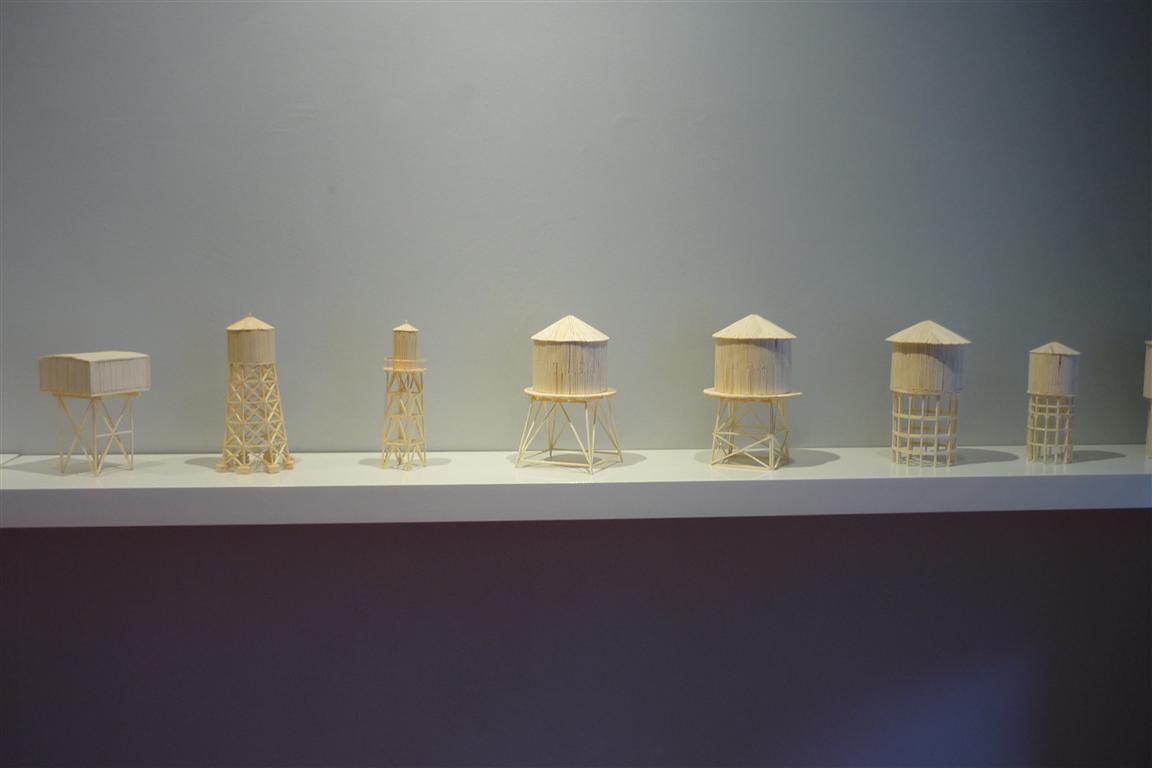
This is brilliant - Tim Taylor is building scale matchstick models of all the water towers illustrated in the Hilla and Bernd Becher's book "Wassertürme"! This fantastic book covers water towers in Europe and the U.K. and some from America too. The towers are being built at precisely the size they appear in the Becher's plates, within the book. Hence they are not actually in scale with each other, but are all of a similar size. Tim is transforming their photographical record of the water towers into his own reality, so to speak. Wassertürme is also available in English (ISBN 026202277X) it was dubbed the "Old Testament" at the last BWTAS meeting (Barry Barton's book being the "New Testament").

The exhibition is on now and runs until 29th July, and is on at 36 St. Mary's Street, Edinburgh, EH1 1SX. Details can be found here. A sample of Tim's towers are presented below...

Saturday, 2 July 2011

Ormskirk water tower owner seeks information, offers access...


image lifted from http://www.uniquepropertyblog.co.uk 
Last Thursday, Mike Jones and his friend became the proud owners of the Ormskirk Hospital water tower in West Lancashire.


Now Mike is asking if BWTAS members know anything of its history. All he knows is that it was built in 1860 to provide water to the Poor Law workhouse that then became Ormskirk Hospital in the 1950's.


Mike's taken up the standing offer of complimentary membership of BWTAS to tower owners and he would be happy for members to come and look around before they start conversion although he and BWTAS can't accept any liability for injury etc. In today's litigation culture we are compelled to say that.


Mike's also looking for guidance from any qualified members whilst he plans what to do with this fantastic building.


Please contact him on mjhousebuild@tesco.net or mobile 07751 605384. The tower is off Nightingale Walk, postcode L39 2AZ.


Prior to the sale, Burcough-based property specialists Armistead Barnett were saying they expected the demand for this property to be high.


Sales manager David Cowburn told the Ormskirk Advertiser: “This is an iconic, landmark building which offers a fantastic opportunity for those looking to create their dream home. The Water Tower is of particular architectural interest due to its five storeys, side projectile pipes, arched windows and the large water tank on top. Planning permission has been granted for two flats but there is potential to create one huge five-storey residence. It will make for a stunning home.”


The 175 square meter tower was part of the hospital site purchased and developed by Persimmon Homes as Nightingale Walk.


Nearby residents aslo said they were in favour of the developement. Neil Wynne, of Pinfold Road, said: "I would prefer it if someone moved into the water tower."


Ormskirk is also known for another water tower, the concrete 'UFO' at Scarth Hill to the east of Ormskirk. 


Sadly there is also a very large derelict one at Greetby Hill, now obviously a missed development opportunity but in its dotage has become reminicsent of a Victorian folly. An application to convert it into seven apartments in 2001 was later withdrawn. Greetby Now  and Then.


Thursday, 30 June 2011

The ultimate project?: Cold War water tower up for sale


When Southern Water unloaded a portfolio of properties in 2004, architect Stephen Luxford purchased the Braithwaite water tower at the former Greenham Common airbase and then got planning permission to convert it into a house. That was a bit of a shock to the local council as they expected buyers would cut it up for scrap and put a traditional house on the plot.

We haven't heard anything for a while but Stephen has just been in touch to tell BWTAS:

"I’ve had the planning extended to 2013 and due to my business being London based, I have given up on carrying the scheme forward myself and the tower is going to auction on 27th July 2011 with www.romans.co.uk – guide price £50,000. "

Stephen told BWTAS before that a build cost estimate is tricky because of unusual nature of the build but at £1200 to £1500/m.sq (quite a high rate) it would be in the region of £160k to £200k.
The auction listing is at http://www.romans.co.uk/Property/40980


Water tower gets robo-clean


First Water Tower Robot Clean for Panton McLeod


29th June 2011


Water quality engineering firm Panton McLeod has completed another first in its work within the UK’s water sector after cleaning a storage tower with robotic technology.


The firm used its VR600 cleaning robot to clean the interior of a water tower in Wiltshire for Wessex Water while it was still active and in service, ensuring minimal disruption for customers in the region.

The project at Minety Tower near Wootton Basset represented the first time that Panton McLeod has ever used the innovative machine to clean an elevated water storage structure in the UK.
In order to access the facility, the firm had to hire a crane in order to lift the robot to the top of the 35 meters high tower before disinfecting the machine and lowering it into the structure.


A team of operators then manoeuvred the remotely-controlled machine throughout the interior of the structure – in order to remove any build up of natural materials on the floor of the facility. The routine work ensures that the drinking water stored in the tower remains at the highest quality levels.


Paul Henderson, operations director at Panton McLeod, said: “We regularly use the VR600 machine for cleaning service reservoirs and storage tanks across the UK. In recent years, the machine has been a vital part of our work for some of the biggest companies in the water sector, including Scottish Water and Severn Trent Water.

“However, before the project at Minety Tower, we had never used the robot to clean a water tower. It represented a big challenge for our underwater team, but we were able to use our expertise to ensure that the project was a success.


“The most challenging aspect was lifting the robot to the top of the 35 metres tall tower in the first place, so we could insert it into the facility and start the cleaning process. We had to hire a special 55 tonne crane to hoist it to the top, but once this was complete, the rest of the project was fairly straight forward.


“We’re delighted with how smoothly the whole cleaning process was carried out, and proud of our team who ensured that this challenging job was completed swiftly. We’re always happy when we identify new ways to deploy our technology, and we hope that this project will lead to more water tower cleans in the future.”


The VR600 is a special tracked robot that is manoeuvred along the floor of any water storage structure and removes any sediment build up on the floor of the structure. It can also be used to inspect the condition of the water tanks, including checking the walls and interior of the facilities for corrosion or damage.

Panton McLeod also uses a specialist ROV inspection robot which is manoeuvred like a submarine through the water in a service reservoir and is able to inspect the walls of the tank, joints, and the roof soffit for damage or leakage.

Both machines are remotely operated from the surface and fitted with cameras and lighting equipment, allowing staff controlling the sub to assess the interior of the tanks. They are also used solely within clean potable water environments and meticulously cleaned and disinfected prior to every use to ensure they can be safely used in the public water supply, and Panton McLeod conducts rigorous tests before and after each inspection.

More information about the machines and Panton McLeod’s other services for the UK water sector can be found at their
website

--


You can see the VR600 in action on YouTube


Water tower tanks are traditionally cleaned and serviced by taking them offline, draining them and then sending workers into the tank via the access hatches to sweep and flush the built-up sediment down the overflow/waste line by hand. Sometimes a small rowboat was lowered inside for inspections. We suppose the health and safety regulations now make the cost of cranes to lift robot vacuums (basically high-tech pool cleaners) into the tank a cheaper option.