Latest Tweet

Saturday, 6 April 2013

Jumbo Information Panel Unveiled...


About 50 people congregated by Jumbo, to see Colchester's MP, Sir Bob Russell unveil the interpretation panel that the Balkerne Tower Trust had erected, on the Council landscaped area next to the tower. For the first time ever, the thousands of people who pass by will now be able to read about this magnificent building.

Below is a YouTube video of the event, further images and details of the support for this panel may be found here.

Monday, 1 April 2013

Jumbo shows his feet again!

When Nat Bocking was interviewed by Chris Wilson, for BBC Radio 4's programme, "Saturday Live" outside Jumbo in Colchester, the tower was masked by horrible hoardings. This eyesore not only masked the view of Jumbo, but the vandalism taking place behind. After a long legal battle, the hoardings that should have been removed by August 2007, finally came down a few days ago. Click on the pictures for a larger view of these Grade II* feet.

Images © Brian Light.             South elevation                                             Front, West elevation

Sunday, 31 March 2013

BBC News Water Week


In July 2002 the BBC News broadcast a series of programmes about water and its importance to society. It included several short films of which two featured water towers.

BBC Water Week, it said, was the biggest examination of the water industry ever done by a broadcaster. It looked at how water and sewerage companies in the UK have been measuring up and in what way consumers and the environment have benefited or suffered as a result.

Some of the films were very critical, rightly so, of several aspects of the water supply. 
The film 'The Profits Pump' examined the tricks of the trade used by some water companies to boost returns to shareholders at customers' expense. 

Others examined the rich architectural and engineering heritage of water supply, waste treatment and water towers. Historian Richard Gill of the Victorian Society took viewers around Luton's magnificent but derelict Bailey Hill Water Tower which has since been converted into a luxurious home.


The films are archived in Real Player format, they're very lo-fi but watchable. BWTAS suggests watching them as they're very good but also, if they get enough traffic, the BBC will be encouraged to maintain access to them.


Sunday, 24 February 2013

A Right to Be Clean: Sanitation and the Rise of New York City’s Water Towers


30th Street, between 7th and 8th, 2012.
During the morning rush hour in New York City, tourists stand out as being the ones looking up. It’s possible that they see more clearly what most New Yorkers take for granted: water towers. Those archaic looking wooden structures that grace the rooftops of almost every New York City building play an integral, though often overlooked, part of watering this urban center.

Read More

Monday, 18 February 2013

Raydon gets a new Roof !

The water tower at Raydon, Suffolk, recently received a new 2.7 tonne, aluminium roof, as part of an £800,000 refurbishment. The refreshing aspect of this refurbishment, is that on completion, it will return to use as elevated storage for potable water!

The 1954 reinforced concrete water tower, built by the then Samford District Council, had a steel roof that was no longer watertight. It is vital that the treated water stored inside the tower is protected from any possible contamination. It was decided that the best way to ensure this, was to replace the roof entirely and refurbish the whole tower at the same time. The 300,000 gallon steel tank within the concrete structure, also required its inside coating stripping off by shot-blasting and re-coating, prior to the new roof being fitted last Thursday.

The 50 foot diameter roof arrived as a kit – like a giant flat pack. Anglian Water’s contractors, @one Alliance, put it together in the carpark of the nearby golf course before hoisting it into position with a crane.

The tower, which serves 17,000 people in and around Raydon and Alton, has been out of use for about a year since it was found the old roof was deteriorating. The tower at O.S. Grid Ref. TM 04745 38111 provides storage to balance flows from the treatment works and security in the event of a failure as well as maintaining constant pressure.

Images and information kindly supplied by Anglian Water.

Ferrers

Monday, 28 January 2013

Mackintosh Harebell Tower

BWTAS correspondent David Blackburn writes in:

 Q. What do Charles Rennie Mackintosh, a harebell and the Glasgow Herald have in common ?

 A. (naturally) - a water tower

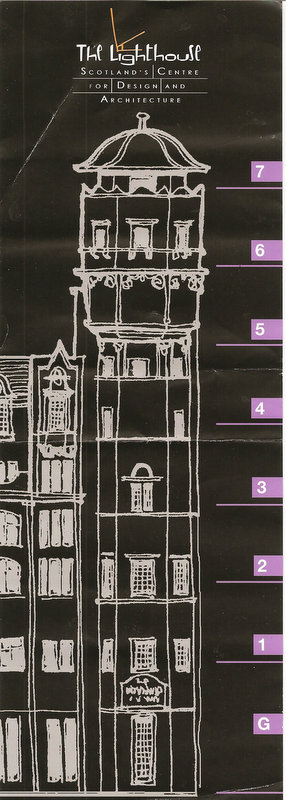
I came across this hidden gem on a brief visit to Glasgow earlier in the week. On the trail of Charles Rennie Mackintosh, I visited the Mackintosh Centre in a building called the Lighthouse. Hidden down a passageway off bustling Buchanan Street, totally surrounded by tall buildings and a multi storey car park , the building once was the factory where  the 'Glasgow Herald' was produced .  It has a water tower rising 3 storeys above the 4 storey factory, part of the original CRM design. It's possible to climb up the tower via a magnificent internal helical staircase and go out on to a small viewing gallery.

Its very difficult to photograph and short of a helicopter , its only feasible to do so via a viewing gallery in a separate part of the building (thankfully accessible by lift!). But pics have to be taken through glass and don't give the best view of the tower. In particular, the view of the cupola does not show off  Mackintosh's harebell design properly.

A hidden , and interesting, tower with lots to discover in the rest of the building too.


We hope David didn't have to 'cough up' very much to see the harebell... (sorry)


Saturday, 26 January 2013

Water towers in broadcasting

A few minutes after the feature on BWTAS on BBC Radio 4 'Saturday Live - Jumbo Edition', surely a moment of broadcasting history, our chairman had a phone call from a Bob Painter (87) who lives near Ludlow.  He was pleased to hear of our attempts to keep the water tower bit of history alive, and said when he worked for the BBC he was on the first live broadcast by the Queen at Sandringham in about 1957. The image was beamed in relay from transmitters on the top of water towers: he mentioned Friday Bridge, Barden Hill, Sutton Coldfield and on to London.  In case anyone wants to get in touch with Bob about his participation in broadcast history contact BWTAS.

The BBC World Service have a nice history programme Witness that looks at an event from a different angle interviewing the unusual eyewitness. They ought to talk to Bob.


H M The Queen has a page about her Christmas broadcasts. 

There are reminiscences of historic outside broadcasts at the website of the Alexandra Palace Television Society. 


Thursday, 24 January 2013

Saturday Live - Jumbo Edition


Proffered by the committee of BWTAS after a request from the BBC, I was interviewed by Chris Wilson, Producer of BBC Radio 4's programme Saturday Live outside Jumbo in Colchester. This item is scheduled to air on 26th January 2013.

The show's format is "extraordinary stories and remarkable people"  and is presented by Sian Williams and The Reverend Richard Coles.


I don't profess to be the latter but there are many extraordinary stories about water towers and Jumbo's story arc is perhaps typical of them all. An engineering marvel, an object of immense civic pride and a symbol of mankind's triumph over nature; it and the people behind it are forgotten and a safe reliable water supply is taken for granted by the public yet within a lifetime ago things were very different.


Babylon in D W Griffith's 1916 'Intolerance'
On the misty November day I met the BBC, Jumbo was looking more dilapidated than when I last saw it. The years of neglect and the forces of wind and water have not been kind and there were obvious signs of forced entry as we walked around its massive feet. It seemed to us like walking around a massive elephantine sculpture in Babylon or amongst the columns of the Acropolis. We were told by Brian Light of the Balkerne Tower Trust that the owner has now been told to remove the wooden hoarding around the base which has been hiding all kinds of sins being carried on behind it and which also blocked what had been planned to be open space, so it would probably be replaced with wire fencing.

I hope that will make the area a bit more attractive, as it once was, although the future of Jumbo is still very uncertain. It has turned out to be a white elephant for the developer who bought it. Though there are people with well prepared plans that could put it to good use for the benefit of Colchester, and have been trying to do so for years, that non-profit body can't raise what the developer paid for it in the heat of the bidding.

© Balkerne Tower Trust
The programme has now aired. You can listen again and catch the item at the 25 minute mark.

In the intro and outro, the reverend mentioned the water tower in his parish at Finedon near Peterborough as a companion to his church. I must agree it is rather a fine 'un. 

Saturday, 5 January 2013

Settling In


A brand new follow-up episode of the Settle water tower restoration is to be shown on Thursday 31st January 2013 - 9pm to 10pm on Channel 4 'Restoration Man' 

The programme shows the project 'one year on' and reveals a fascinating new historical discovery.

Thursday, 29 November 2012

Ormskirk's Water Towers

A report by Edward J McCarthy:

Ormskirk in West Lancs currently has 3 water towers left but has had others in the past.

The majority were built by Ormskirk Urban District Council, and then this function was served by West Lancashire Water Board, later North West Water, and then United Utilities. West Lancashire Water Board was set up following an Act of Parliament in 1907.

Tower Hill.

© Copyright Chris Denny and licensed for reuse under this Creative Commons Licence

Located on Tower Hill in Ormskirk. Locally, Ormskirk is well known for the concrete, mushroom shaped water tower on Scarth Hill. Less well known is this one just off Greetby Hill. The photograph was taken in 1987 when the tower was not quite as derelict as it is now.

It was built in 1853. This water tower became a listed building in 1976.

Some information on it-

Water Tower on Tower Hill II* Water tower. 1853-4. For Ormskirk Local Board of Health; now derelict. Coursed squared sandstone, slate roof (dilapidated). Square plan. Romanesque style. Tall tower with 2 narrow full-height Romanesque arches in each side, all with stepped surrounds and arch-bands, linked by an impost band carried round; plain frieze with carved grotesques at the corners, and very emphatic corbelling in machicolated form, surmounted by a large tank enclosed by what appears to be ashlar walling. Pyramidal roof now lacking most slates. HISTORY: unusual survival of early Local Board waterworks structure. Conspicuous landmark on east side of town.

There have been plans to convert it into homes but nothing has been successful yet.

Victoria Tower.

Victoria Tower @ SD 42388 08611, Built in 1897 and demolished in the 1980.

There is still a boundary slab from the building near Nursery Avenue in Ormskirk. There is a photo from 1955 in the Lancashire Lantern: Image Archive.

Ruff Wood Tank.

There was a Braithwaite tank in Ruff Wood on Ruff Lane Ormskirk.

In the woods are the remains of an old quarry. This is all that is left of an important site which provided sandstone to build houses in Ormskirk during the 19th century.

Ruff Wood is located on Ruff Lane/ Vicarage Lane in Ormskirk.

Ormskirk Hospital Water Tower.

© Edward J McCarthy

Ormskirk Hospital Water Tower is currently being converted into 2 homes. Located on Pinfold Rd Ormskirk where the old hospital buildings are. This was still in use in the 1980’s -90’s. A smaller tank was attached to it but this part is no longer there. The older hospital site was sold to Persimmon Homes and they sold the water tower privately in 2011.

© Edward J McCarthy

Further photographs taken at this location may be found here. Ormskirk Hospital water tower is featured on Amy Caine's Blog where there is further information and additional photographs.

Scarth Hill.

The original tower known locally as the “pepperpot” was built in 1879. It was demolished in 1974. The new water tower was in use from that time. Pictures of the old and new tower and also inside the Pumping Station that has now been converted into homes, may be found on the wiganworld website!

The reasons why the Ormskirk Water Towers were demolished and the new 1974 tower was built, is detailed in a planning application report submitted to Ormskirk U.D.C. by the West Lancashire Water Board, in March 1973.

Edward McCarthy (West Lancs resident)