Latest Tweet

Showing posts with label BWTAS. Show all posts

Thursday, 10 November 2016

A Water Tower Windfall!!

BWTAS was recently contacted by Peter Loosley, who had been photographing water towers since 1976. He was unaware of our existence until his wife, Pat, read about us in Bill Bryson's book "The Road to Little Dribbling". He was keen that his collection of over 1,000 water towers worldwide went to a good home and offered them to us. A small delegation from BWTAS was assembled and went to meet Peter and his wife…

From left to right: Barry Barton (President), Andy Norris (Hon. Treasurer), Pat & Peter Loosley,
Wil Harvey (Chairman) & Ferrers Young (Archives)

On arrival we were greeted most warmly and enjoyed good hospitality… After coffee, biscuits and home made cake, Peter gave us a PowerPoint presentation that he'd previously created: "Living History — A Millenium of Water Towers Worldwide" that covered the development of materials and structures for the collection, storage and distribution of water through the ages.

This naturally created some discussion! Of particular interest was a tower, the like none of us had previously seen — one with a toroidal tank! This is located in Ciechanów, Poland, designed by Jerzy Michal Boguslawski and built in 1972, but now out of use. The tank is supported on a hyperbolic steel lattice base. Unfortunately I haven't been able to establish its capacity, but measuring it on Google Earth™ it would appear to be somewhere in the region of 400,000 gallons.

We were able to continue our chat about water towers over a most enjoyable pub lunch — we had a lot to catch up on… Hopefully we'll see Peter and his wife again. We left then left with Peter's collection of water tower photographs.


Ferrers
Photograph of Ciechanów water tower reproduced from Wikipedia under the Creative Commons Licence

Saturday, 9 October 2010

West Bar picnic

We are organising a social get-together for BWTAS members on Saturday October 9th at Thorpeness, on the Suffolk Coast: a picnic (or, if the weather is bad, lunch in the café or pub), followed by a guided tour of West Bar water tower by kind permission of John Smith. Thorpeness is well-endowed with towers: the famous ‘House-in-the-Clouds’, a nearby windmill which once pumped water to it, and the magnificent brick-built West Bar supported on an arch over the road. All are within a few minutes walk. Meet at 12:00 the café by the lake (postcode IP16 4NW, or click here for google map) - you can’t miss it, Thorpeness is a small village. There is a car park just South of here, on the East side of the road. Following the social we shall have a tour at 2pm. Note, this is John’s home and therefore the group size will need to be limited to 10 or so.


Friday, 23 January 2009

Dereham tower slated for redevelopment

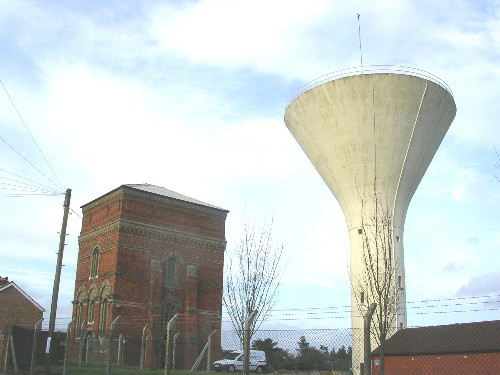
BWTAS had a enquiry today from the Eastern Daily Press asking for a quote regarding the Victorian water tower (the one on the left of the image) as an application for redevelopment into housing has been made. 


WGS84: 52:41.2766N 0:56.7516E


For the record, BWTAS takes no position on preservation but this would be by no means the first water tower to be converted and, as long as it
 was sympathetic, conversion is preferable than knocking them down.


Dereham’s Victorian tower isn't thoroughly exceptional although it does have nice Romanesque details and some lovely glazed terracotta which later towers don’t have. This is almost non-existant in Edwardian towers although they are much the same in construction. Those Victorians; things not only had to be functional, they had to be beautiful.

Some converted towers have been spoiled by the addition of stairways and extensions and insertion of windows and planners should be careful if the conversion involves removing the tank (if it is exterior) as that would alter the proportion of the building which the Victorian and Edwardian engineers were very considerate of. In Dereham's case the tank is interior. At Leiston the tank was removed but dummy tank walls were erected to preserve the original profile. Sometimes an exposed tank has been replaced by a glass structures of similar size acting as a rooftop garden or enclosed gazebo.


Last time we looked, the Dereham tower appeared intact and as it is on a waterworks site and if the EDP is looking for someone to speak up for the preservationists;  historically it has proved hard to prevent redevelopment of water towers on heritage grounds because they are mostly undistinguished but in East Anglia, the stock of intact Victorian water towers is diminishing and before the very last one goes, perhaps one should be preserved to show how they work and what role they have in bringing our most vital resource to our homes. Dereham would appear to be an excellent candidate for this.

There have been proposals and expert recommendations to preserve Jumbo in Colchester in this role which would be ideal but the chances of that happening now are remote (but not impossible!) whilst it languishes in the hands of a property developer. The planning committee considering this development application must consult with experts and not rely on outdated surveys commissioned years ago about the present state of our water infrastructure’s heritage and preservation before granting permission to remove Dereham from contention. By their own admission, English Heritage's reports "give an insufficient set of criteria for judging the relative importance of different water towers." Dereham's tower is near the Norfolk Rural Life Museum and BWTAS has demonstrated with its tours and open days that there is ample potential in a water tower as a heritage attraction.


update:

BWTAS member Ferrers Young has contributed the following:

The tower at East Dereham was built in 1889, from my research, although the date of 1881 is often quoted. I believe the waterworks was built, despite a "Keep Dereham Dry" campaign - as the residents thought the scheme too expensive. 

In 1881 East Dereham¹s original borehole was sunk into the chalk underlying Cemetery Road at a cost of £4,000. By 1889 treatment works had been completed together with a square brick water tower into which the treated water was pumped by a steam engine (³Dereham Past and Present², p32). Before this date, water was obtained from wells or pumps. Most properties had their own but there were three public pumps; in the Market Place near the Assembly Rooms, at the junction of London Road and Baxter¹s Row and in Washbridge (³Looking Back at Dereham, p28, 29 see folder ŒDereham¹²). Located in Cemetery Road, O.S. Grid Ref. TF 99112 14218, Capacity 30,000 gallons.

Notes: The tower appears much as it did originally, but no longer has the penthouse on top of the roof as illustrated in the ³Story of EAST DEREHAM², p66. Grade II listed on 22nd June 1984. IoE #219497. 


16.10.09 Sadly the EDP has since removed this story from its website.


Saturday, 5 July 2008

BWTAS talk at NIAS


Everything you wanted to know about Water Towers but were afraid to ask.


Nat Bocking and Ferrers Young from BWTAS will give an illustrated talk to the NORFOLK INDUSTRIAL ARCHAEOLOGY SOCIETY on Thursday Oct 2nd (their meeting are the 1st Thurs of each month) at 7.30 pm.

Talks are held in the Stanley Cooper Room at the Charing Cross Centre, 17-19 St John Maddermarket, Norwich.

Admission is free. Visitors or prospective NIAS or BWTAS members are most welcome. The room has full access including a lift and toilets close by. Click here for a Multi-Map

Friday, 4 July 2008

Houghton Hall Water Tower Visit

BWTAS is planning to visit Houghton Hall in Norfolk, site of Britain’s finest domestic water tower dating from the late 1720’s and only taken out of use recently. It’s a beautiful Palladian structure sited at a focal point of a magnificent garden vista. According to Barry Barton “enough remains of the original system to make Houghton Hall’s water supply – and its water tower – of considerable historical significance”. This is an open event. We plan to rendezvous at the car park at 12.15 where we'll meet a curator who will walk us over to the tower and show us inside.

The house is the former home of Robert Walpole and is open to the public and has a restaurant and gift shop. The house opens to the public at 1.15 pm. There are two types of entry fee to Houghton: inclusive of the house £8, all except the house £5.

Please contact Wil Harvey at harveys@care4free.net and let him know you if plan to be there.

12.15

Sunday 6th July 2008

Houghton Hall,

King's Lynn,

Norfolk

PE31 6UE

About BWTAS

The British Water Tower Appreciation Society exists to connect enthusiasts of water towers to share their enjoyment of their artistic, cultural, architectural, historical, social and engineering significance

We are a society that tries not to burden ourselves with administration, committees and all that stuff (although we have them). BWTAS is whatever the members can make of it themselves.

PURPOSE

The society is a forum for the exchange of information and it supports members in recording their local water towers and researching into their history. It hopes to share that work through the pages of this blog. It has established reciprocal links with other bodies such as the Folly Fellowship and the DeutschWasserturm Gesellschaft. Internationale.

WHAT IT DOES

So far BWTAS has staged exhibitions of water tower art and crafts, given talks, organised tours, manned exhibition stands, written guidebooks on water towers, been on radio and TV to tell people about water towers and it hopes that you can help it to do more. Amongst its members are architects, artists, historians, civil engineers, utility company employees and tower owners as well as 'just plain folk'.

The society welcomes enquiries from tower owners, researchers, historians, architects, students and so forth looking for information on water towers and it knows of experts and resources it can direct them too. We also have members prepared to give presentations to interested groups.


ETHOS

BWTAS is non-political (such as taking a position on phone mast issues) and is not preservationist but examples all over the world show that water towers of any size and material can have commercial and social benefits by their preservation. Many redundant water towers in Britain have been put to imaginative reuse. 

Too often these structures are claimed to have "no historical or architectural merit" because their documented history isn't available or hasn't been preserved. BWTAS encourages the open exchange of information so that decisions on these matters can be taken properly.

The security of the public water supply once made it necessary to keep information on water towers out of the public domain but the privatisation of the public water companies unfortunately caused the loss of important archives before that restriction was no longer required. Much of the history of British water tower engineers, architects and builders who led the world in this technology has been lost but many members are trying to secure what remains.

BWTAS encourages the responsible enjoyment of water towers which it thinks is best done from a distance. Both disused and working water towers have numerous dangers to the unprepared. Besides risks of death by falling (which we see too many reports of) even the base of a working tower can have unstable masonry or fixtures, disease carrying vermin, open pits filled with deep sludge, asbestos, live wiring and a host of other hazards. If you like to explore towers please stay away from going into them without permission, it annoys their owners. You can join BWTAS and help us organise safe access for study and public tours instead.

JOINING

Membership is £5 for adults and £1 for aged 16 and under. Since the founding in 2006, BWTAS has not had to ask the members for renewals but will reserve the right to do so.

To apply, send your contact information and no smaller than a letter (DL) size SAE with 1st or 2nd class postage for 30g and £5 or £1 made out to BWTAS to

Membership
BWTAS
Green Gables, The Street, Wenhaston, Suffolk IP19 9DP

Tel: 01502 478606
email bwtas@hotmail.co.uk
For family or group membership, send extra SAEs with 1st or 2nd postage for 30g.

Enquiries on any topic are best addressed in a letter (snail mail) to this address as not all the committee or our membership and numerous contacts have email.

MEETINGS

Meetings are held whenever people want to get together to talk about towers and make plans to promote their appreciation. Dates will be posted on this blog.

HOW BWTAS STARTED


In 2002 photographer Nat Bocking had the idea of writing what became 'A guide to the water towers of East Anglia' because he had been photographing water towers for local landscape studies but he could not find any information about who built them and why.

Seeing a gap in a market, he spent far too much time and a great deal of his money on travelling and research but he finally found a source of funds to pay for 2200 copies of his free guide to be printed. 

He enlisted the help of graphic designer Paul Welch and by September 2005 it was ready and in a few short months all the copies given to museums and TICs in Suffolk and Norfolk were greedily snapped up. The Institution of Civil Engineers now offers a scanned copy.

The guide then led to Nat's appearance on local TV and radio which was seen by retired teacher Brian Light who was preparing a water tower history of 'Jumbo' the water tower in Colchester. In Wenhaston artist friends Wil Harvey and Andy Norris, who had been painting water towers for years, realised that Nat lived only a mile away. Eventually so many people interested in water towers got in touch with each other that it was decided to form a society. In May 2006 the British Water Tower Appreciation Society was formed at the Star Inn, Wenhaston.