Latest Tweet

Showing posts with label norfolk. Show all posts

Tuesday, 3 March 2015

Castle Acre Open Day 22nd March 2015


Photographer Dennis Pedersen has always had a thing for water towers. He says he was inspired by the futuristic cartoon The Jetsons and Gerry Anderson's Thunderbirds. Never did he think that he might one day be the proud owner of one.


Last year he bought a decommissioned Braithwaite type tower just outside Castle Acre in Norfolk.

To his dismay though he found that the presumed fate for the Meccano-like structure by the vendors and local planners was its demolition for its scrap value. However Dennis recognised the tower as an important part of the area's rural heritage and he had a vision that this unused resource could "create an outstanding example of sustainable recycling."


Inspired by the work of the Landmark Trust and the Living Architecture Project, he commissioned cutting edge architects Tonkin Liu to envisage a way to preserve the structure with minimal changes yet allow it to be reused for accommodation. Now he's holding an open day at the tower to show local people and water tower enthusiasts his plans.

BWTAS members have been especially invited to come along and some will be available to explain the engineering history and cultural significance of water towers. Dennis and his architect will be showing a model of a potential conversion and serving tea and biscuits and giving free tours of the tower from 10 AM to dusk. If you'd like to come and have a nosey around or see the plans or show your support, all would be very welcome.


Please note that access to the tank is restricted by ladders and Dennis can only take small groups up there. The risk assessment for any water tower is that heights and places only normally accessible to trained personnel can be dangerous and so your visit will be entirely at your own risk. You will have to be suitably fit if you want to climb up to visit the tank. The site is overgrown and derelict and appropriate footwear and clothing are advisable. No children or persons under 18 may go up the tower. 

Please check this page for updates before you set off as this event is dependent on weather and jobsworth. The tower is .2 miles from the village where there are numerous attractions and facilities. Please park considerately.

This is a rare opportunity and BWTAS is profoundly grateful to Mr. Pedersen for his offer of hospitality.


Sunday 22nd March, 10 AM to dusk
Massingham Rd
Castle Acre

www.dennispedersen.com

Friday, 27 January 2012

Soup Tower chairman reflects on icon of Kings Lynn


Lynn: Tower loss is a blasted waste


CAMPBELL'S SOUPS TOWER A trip down memory lane Raymond Monbiot sifts through photographic memories of his time as UK chairman of Campbell's Soups. On the right of the picture is the Ogilvy Award which was won by the King's Lynn UK factory in 1984-85. The first time it was had been awarded to a factory outside the United States


Published on Thursday 26 January 2012 08:56


A former UK chairman and chief executive officer of Campbell’s Soups regards the destruction of the company’s iconic water tower at Lynn as a piece of town planning vandalism.


Raymond Monbiot, who still lives close to Lynn, ran the company for most of the 1980s though he was quick to emphasis his view was no criticism of Sarah Griffiths who was chosen to set off the charges that brought down the tower.


“They have removed an icon. The company did a lot for the town. They brought wealth and employment to King’s Lynn.”


He remembers when the tower was a flagship on the edge of The Fens. “When it was built in 1958 it was surrounded by green fields. Now it is surrounded by large stores and supermarkets.”


Campbell’s, a company with factories across the world, decided to site their first factory in Europe in the UK, some 3,000 miles from their head office in the United States. They chose King’s Lynn for their head-on battle for the British market against giants in the business like Heinz, Cross and Blackwell and Batchelor’s.


He said: “They came to King’s Lynn because of the clean air, clean water and the quality of the local produce.”


Monbiot was made UK chairman of Campbell’s in 1982 and later, in the mid-eighties, his responsibilities were increased when they opened a second factory in Salford in Lancashire. Such was the success of the two factories that the then Prime Minister, Margaret Thatcher, visited Salford to emphasise the importance to her government of the success of the American company’s entry into the British market.


During his time at the helm of the company there were 500 or so employers at Lynn.


Another important reason for choosing the town was that staff were ‘food friendly’.


“They came from an agricultural background and were well used to handling fresh produce.”


Many of the vegetables arrived at the factory with Fenland soil still clinging to them.


“In the factory there was always a wonderful smell of fresh food. We were a real quality food company,” he recalls.


But he also remembers the tight hold the parent company kept on its factories around the world.


He was inundated with books which detailed how to run the business.


“Even the pile of thick index books reached the ceiling. I never read them!”


Monbiot believes he was Campbell’s first British chairman and he used his long experience in the food industry to make sure their venture into the UK was success.


This was largely founded on their condensed soups which a survey discovered were used by eight out of 10 customers as sauces in their cooking, rather than purely as soups.


Emphasising this use was an innovation that helped increase the company’s share of the UK market from six per cent to 17 per cent and had the twin benefit of winning Lynn the company’s Ogilvy Award for success in 1984-85, the first time it had been presented to a factory outside the United States.


This success also meant that Monbiot had more autonomy that most chairman around the world.


“I was tactful but I was determined to run the business my way.”


But the destruction of the water tower marks the sad end to a company Monbiot believes did so much for Lynn.


Its height and size ensured that there was a constant and secure supply of clean water at the right pressure which was used copiously in all stages of the food process including being steam-heated to sterilize everything.


The destruction of the tower removes the last significant landmark of a local company that is a worldwide household name.


“Attempts were made to make the tower a listed building but they failed – I think by the Civic Society. I’m very sorry to see it go”


Now he has are only photographic memories of a company that was once the beating heart of the Lynn food industry


Lifted with apologies from Lynn News for preservation http://www.lynnnews.co.uk/news/environment/lynn_tower_loss_is_a_blasted_waste_1_3449419

Thursday, 15 July 2010

Water Tower Development Diss-regarded

The Diss Mercury reports the Diss water tower plans reported here have been withdrawn.

Applicant AWG Land Holdings had submitted its second application to change the landmark 192 tower in Louie's Lane into two maisonettes.

But the plans, which would have also seen the construction five homes on the site, were withdrawn before a South Norfolk Council planning meeting last week.

The scheme had been recommended for refusal by officers because of the cramped design, lack of parking spaces, and impact on neighbours of the “overbearing” development.

Wednesday, 8 April 2009

Melton Constable, Norfolk (1898)

Melton Constable was a railway town and known as “the Crewe of North Norfolk”. Just as the residents of Merredin, Western Australia benefited from a water supply from the railway way water tower, Melton Constable had piped water supplied by the Midland and Great Northern Railway Company.
The M & GN Railway Company had its headquarters in Melton Constable and built the cast iron water tower in 1898 to supply the locomotives, the vast engineering works and the town. It consists of three conjoined tanks formed in bolted plate sections standing on a platform of cast iron columns with diagonal tension bracing. Each of the tank's 256 external panels was cast with the company’s initials embossed. The tower is still standing - next to the Melton Road, just off the B1354 at O.S. Grid Ref TG 04117 32920 and is currently used for irrigation and I understand that it has a Roll Royce pump. It has a capacity of 125,000 gallons.

Wednesday, 11 March 2009

Welney, Norfolk (1936)

Norfolk's most Westerly public supply water tower has been sold for £11,750. What is to happen to this tower is unknown, but we know its history: Messrs. G. F. W. Bedford sold the 32’ x 32’ plot of land to Anglian Water Services Ltd. on the 16th November 1935 for the construction of the water tower, for the Isleham water supply. The reinforced concrete tower came into use in 1936. An unusual feature is the access to tank is via a ladder and through a triangular hole in the tank, through to the roof. The tower has not been used for a considerable time and was sold by Anglian Water in June 2006. The new owner was unable to develop the tower commercially for bird watching, so put the tower up for sale in early 2007 with a guide price of £50,000. In 2008 the tower featured on the front cover of “The Welney Parish Action Plan” delivered to every household in the Parish - a strange choice, as the Parish Council had previously said they thought it was an eye-sore that ought to be demolished! On the 25th February 2009, the tower sold for £11,750 beating the guide price of £3,000-£5,000 at Cheffins auction. Located to the West of Main Street at O.S. Grid Ref TL 52576 93890, Capacity unknown.

Wednesday, 25 February 2009

Wells-Next-the-Sea, Norfolk (1935)

Following my last posting of the 1953 water tower built by Wells Rural District Council, I thought I'd feature the 1935 water tower built by Wells Urban District Council. Piped water came to Wells in 1936 on completion of the well being sunk on the high ground to the south of the town and the water tower and water mains being laid. Prior to this it was dependent on 350 wells, many of which were susceptible to pollution. All that remains now, is the brick supporting structure and pumping house. It had a 30,000-gallon, Braithwaite tank with a single internal compartment. Located on a hill at O.S. Grid Ref TF 92240 42645, it had a top water level of 125 feet.

The summer influx of visitors more than doubles the winter population and this supply was sometimes inadequate, so in 1962 it was coupled to the supply lines of the Walsingham Rural District Council.

Friday, 23 January 2009

Dereham tower slated for redevelopment

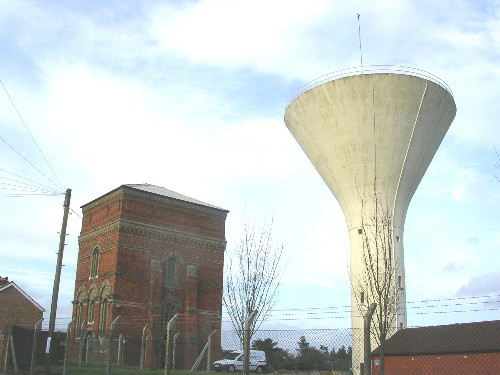
BWTAS had a enquiry today from the Eastern Daily Press asking for a quote regarding the Victorian water tower (the one on the left of the image) as an application for redevelopment into housing has been made. 


WGS84: 52:41.2766N 0:56.7516E


For the record, BWTAS takes no position on preservation but this would be by no means the first water tower to be converted and, as long as it
 was sympathetic, conversion is preferable than knocking them down.


Dereham’s Victorian tower isn't thoroughly exceptional although it does have nice Romanesque details and some lovely glazed terracotta which later towers don’t have. This is almost non-existant in Edwardian towers although they are much the same in construction. Those Victorians; things not only had to be functional, they had to be beautiful.

Some converted towers have been spoiled by the addition of stairways and extensions and insertion of windows and planners should be careful if the conversion involves removing the tank (if it is exterior) as that would alter the proportion of the building which the Victorian and Edwardian engineers were very considerate of. In Dereham's case the tank is interior. At Leiston the tank was removed but dummy tank walls were erected to preserve the original profile. Sometimes an exposed tank has been replaced by a glass structures of similar size acting as a rooftop garden or enclosed gazebo.


Last time we looked, the Dereham tower appeared intact and as it is on a waterworks site and if the EDP is looking for someone to speak up for the preservationists;  historically it has proved hard to prevent redevelopment of water towers on heritage grounds because they are mostly undistinguished but in East Anglia, the stock of intact Victorian water towers is diminishing and before the very last one goes, perhaps one should be preserved to show how they work and what role they have in bringing our most vital resource to our homes. Dereham would appear to be an excellent candidate for this.

There have been proposals and expert recommendations to preserve Jumbo in Colchester in this role which would be ideal but the chances of that happening now are remote (but not impossible!) whilst it languishes in the hands of a property developer. The planning committee considering this development application must consult with experts and not rely on outdated surveys commissioned years ago about the present state of our water infrastructure’s heritage and preservation before granting permission to remove Dereham from contention. By their own admission, English Heritage's reports "give an insufficient set of criteria for judging the relative importance of different water towers." Dereham's tower is near the Norfolk Rural Life Museum and BWTAS has demonstrated with its tours and open days that there is ample potential in a water tower as a heritage attraction.


update:

BWTAS member Ferrers Young has contributed the following:

The tower at East Dereham was built in 1889, from my research, although the date of 1881 is often quoted. I believe the waterworks was built, despite a "Keep Dereham Dry" campaign - as the residents thought the scheme too expensive. 

In 1881 East Dereham¹s original borehole was sunk into the chalk underlying Cemetery Road at a cost of £4,000. By 1889 treatment works had been completed together with a square brick water tower into which the treated water was pumped by a steam engine (³Dereham Past and Present², p32). Before this date, water was obtained from wells or pumps. Most properties had their own but there were three public pumps; in the Market Place near the Assembly Rooms, at the junction of London Road and Baxter¹s Row and in Washbridge (³Looking Back at Dereham, p28, 29 see folder ŒDereham¹²). Located in Cemetery Road, O.S. Grid Ref. TF 99112 14218, Capacity 30,000 gallons.

Notes: The tower appears much as it did originally, but no longer has the penthouse on top of the roof as illustrated in the ³Story of EAST DEREHAM², p66. Grade II listed on 22nd June 1984. IoE #219497. 


16.10.09 Sadly the EDP has since removed this story from its website.


Saturday, 5 July 2008

BWTAS talk at NIAS


Everything you wanted to know about Water Towers but were afraid to ask.


Nat Bocking and Ferrers Young from BWTAS will give an illustrated talk to the NORFOLK INDUSTRIAL ARCHAEOLOGY SOCIETY on Thursday Oct 2nd (their meeting are the 1st Thurs of each month) at 7.30 pm.

Talks are held in the Stanley Cooper Room at the Charing Cross Centre, 17-19 St John Maddermarket, Norwich.

Admission is free. Visitors or prospective NIAS or BWTAS members are most welcome. The room has full access including a lift and toilets close by. Click here for a Multi-Map

Friday, 4 July 2008

Houghton Hall Water Tower Visit

BWTAS is planning to visit Houghton Hall in Norfolk, site of Britain’s finest domestic water tower dating from the late 1720’s and only taken out of use recently. It’s a beautiful Palladian structure sited at a focal point of a magnificent garden vista. According to Barry Barton “enough remains of the original system to make Houghton Hall’s water supply – and its water tower – of considerable historical significance”. This is an open event. We plan to rendezvous at the car park at 12.15 where we'll meet a curator who will walk us over to the tower and show us inside.

The house is the former home of Robert Walpole and is open to the public and has a restaurant and gift shop. The house opens to the public at 1.15 pm. There are two types of entry fee to Houghton: inclusive of the house £8, all except the house £5.

Please contact Wil Harvey at harveys@care4free.net and let him know you if plan to be there.

12.15

Sunday 6th July 2008

Houghton Hall,

King's Lynn,

Norfolk

PE31 6UE