Latest Tweet

Showing posts with label artist. Show all posts

Friday, 15 June 2012

Brooklyn sculpture is fantastic plastic water tower


image from Junk Culture

The BBC reports a Brooklyn-based artist Tom Fruin has used 1,000 pieces of transparent plastic scavenged from various parts of New York to create a sculpture of a water tower.

The artwork is open to the public and can be seen from the Brooklyn and Manhattan bridges and from parts of lower Manhattan.


It is illuminated by the sun during the day and by Ardunio-controlled light sequences designed by Ryan Holsopple at night. It opened on June 7th and will be in place for one year with a light show beginning at dusk and continuing to morning.

Tom Santorelli reports

Inside the sculptor's workshop:


We know it's a load of scrap but is it art? Of course it is.

Tuesday, 29 May 2012

Indian Inspiration


Painting No. 130, Water Tower
Stewart Indian School, Carson City, Nevada
8"x 8", oil on linen panel
September 1, 2011

Standing over the facility, like a giant sci-fi robot, the water tower is surrounded by trees and buildings. It's silvery exterior reflecting the local color. This is painting 6 of 10 in a series painted at the school. 

Source: http://jamesamckewfineart.blogspot.co.uk/2011/09/water-tower.html


The Stewart Indian School in Carson City Nevada served as an off-reservation boarding school from 1890 through 1980, and its stone buildings are an icon of education and life for many American Indians in the West. After the school closed, the buildings were emptied and many became home to state offices. It is listed on the National Register of Historic Places and is comprised of 83 buildings.


Tuesday, 22 May 2012

The Water Tank Project

Word Above the Street is staging a large scale public art initiative to draw attention to water as a precious resource by transforming 300 of New York's celebrated rooftop water tanks into works of art.

Artists, musicians and scientists and New York City residents will redefine the skyline across all five New York City boroughs during Summer 2013.

The event aims to reach millions around the world through social networking, and online multimedia tools with a mission to harness the power of art and technology to build a better world, make art that makes a difference and broadcast art to an ever expanding audience.


You can download a snazzy PDF brochure about it.

Friday, 30 September 2011

180° of Light show


photo by SteveRSVR
180° of Light is a laser installation linking water towers in Rothwell, Desborough and Corby in the British Midlands with laser beams to form a triangle, the alchemical symbol of water. The project is a part of a county-wide series of site specific artworks on  Northamptonshire's rivers, canals, waterways and water towers. There has already been an installation on Northamptonshire's Oxford canal and there will be a further installation at Sywell Reservoir in October. NESTA fellow Jo Fairfax and FLOW manager Graham Callister came up with the idea. Visible from the A14, the project is part of Igniting Ambition Festival and the London 2012 Cultural Olympiad. The lasers shine from 7.30 to 9.30 pm until 2nd October 2011. Its website gives a raison d'etre:

This site-specific artwork highlights the architectural beauty, science and necessity of water towers in today’s society. Among their many uses, water towers provide pressure to maintain the safety of the water supply, without which water may not spray from a tap with sufficient FLOW.

By using several strikingly bold lasers, this site-specific, large scale installation produces a formal dynamic between the imposing circular drums of the water towers and the stunning, elevated triangle of light which unites them. Dominating the Northamptonshire landscape, 180° of Light encourages conversations both of architectural form and journey.

The artist, Jo Fairfax, described the installations:

“Creating a giant laser triangle hovering in the sky makes me smile. Each water tower forms the corner of the laser triangle creating a conversation in form - the circle of the water drum with the triangle of light. The journey of light is evident and the journey of water is implied, another conversation. The moving striated visual effect created as the laser light breaks down over distance implies a sense of journey. The water tower drum containing water held high, water reader to enter and exit, implies a journey. The two meet either side of the water drum. Both dynamic, one in its speed and break down, the other in its potential and pressure. Water and light, like siblings with a story to tell”.

Key funders included Arts Council England, Legacy Trust UK, Northamptonshire County Council, Anglian Water and Breath of Fresh Air, East Midlands.

More information about FLOW


BBC news slideshow http://www.bbc.co.uk/news/uk-england-northamptonshire-14983682


Here's map of the laser 'field' to aid viewing:


View flow towers in a larger map


BWTAS context:

Illuminating water towers has a long history and was commonplace when water towers were novel and objects of civic pride. The Thorpe Hamlet water tower in Norwich was illuminated for a year to commemorate George V's silver jubilee in 1935. A couple of generations later, illumination of towers was used as way of reasserting their monumental quality and renewing civic pride as part of regeneration schemes. Cranhill Arts Project in Glasgow illuminated their local tower a vibrant green with white spotlights and nearby the Craigend water towers were illuminated as part of Glasgow's reign as the European City of Culture. The city council's lighting strategy webpage asserts: "Good lighting helps to increase vitality and improve ambience. It contributes to a sense of identity and place, makes for a safer, friendlier environment and also supports and complements other regeneration initiatives."

Saturday, 23 July 2011

Wassertürme

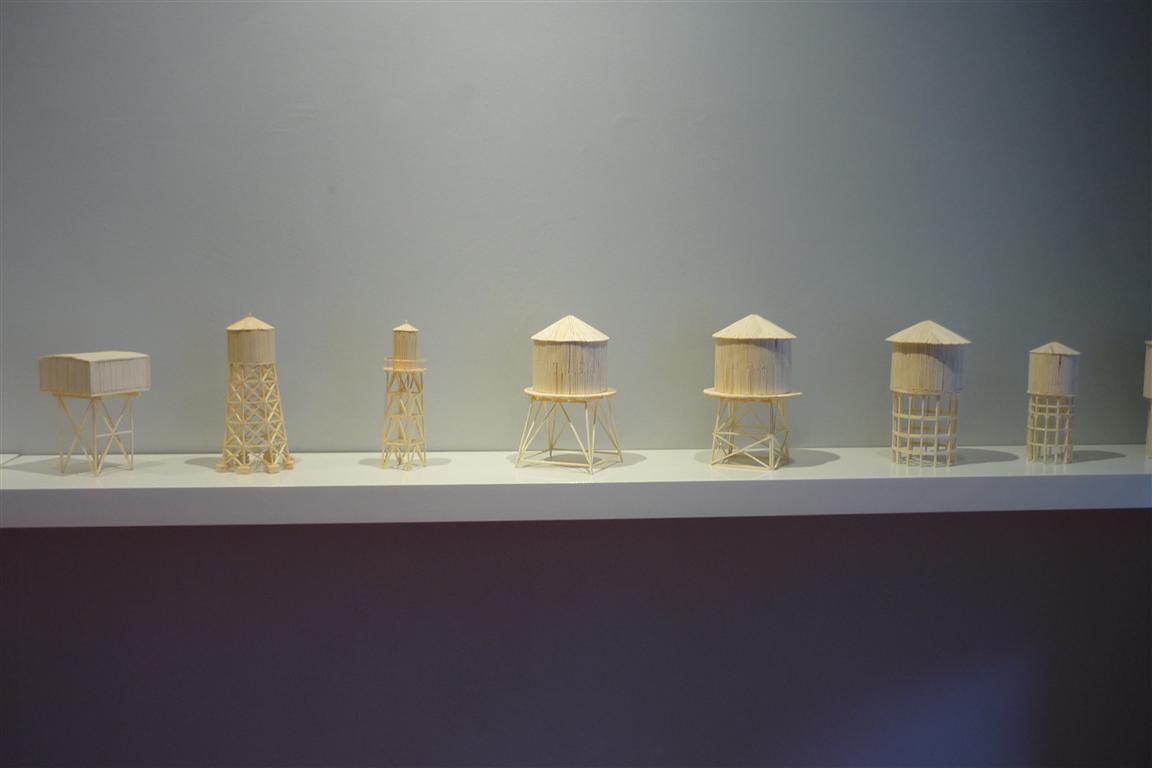
This is brilliant - Tim Taylor is building scale matchstick models of all the water towers illustrated in the Hilla and Bernd Becher's book "Wassertürme"! This fantastic book covers water towers in Europe and the U.K. and some from America too. The towers are being built at precisely the size they appear in the Becher's plates, within the book. Hence they are not actually in scale with each other, but are all of a similar size. Tim is transforming their photographical record of the water towers into his own reality, so to speak. Wassertürme is also available in English (ISBN 026202277X) it was dubbed the "Old Testament" at the last BWTAS meeting (Barry Barton's book being the "New Testament").

The exhibition is on now and runs until 29th July, and is on at 36 St. Mary's Street, Edinburgh, EH1 1SX. Details can be found here. A sample of Tim's towers are presented below...

Wednesday, 25 May 2011

Save the Sudbury water towers campaign

Mind we are talking Greater Sudbury, Ontario.

When plans were afoot to demolish two iconic water towers known as 'Pearl Street' and 'Pine Street' respectively in Canada's Nickel City, a group of local artists put up an impressive resistance; not by sit-ins and petitions but by mounting exhibitions illustrating the towers' value as cultural objects far beyond their municipal purpose.

Built in 1956, the two towers stayed in use until 1998 when they were decommissioned. Standing tall on sites overlooking the city, the towers turn an otherwise unremarkable cityscape into an interesting panorama.


The present outcome appears to be that the city has voted to remove Pine Street but in 2010 a developer bought Pearl Street and plans to convert it, meantime exploiting its landmark value by erecting 'art boards' (plain speaking: billboards) to raise the revenue to fund this. Many ideas are floating around for turning it into a heritage centre, an art gallery or viewing platform or all three. A feasibility study has been undertaken of various proposals citing the successful redevelopment of other surplus water towers.

This was all started in 2009 by Joel Kimmel, an illustrator originally from Ottawa who became fascinated with water towers on a trip to New York in 2005. He loved them so much that he moved to Brooklyn and roamed the streets beneath the towers for two years. In 2009 he moved to Sudbury where he immediately chose the water towers as his favorite landmarks.

Joel and his chums got 50 other artists and photographers in Sudbury and lovers of water towers from around the world to submit their artwork to be displayed on their website and in an exhibition held in 2010 that raised awareness and showed the City of Greater Sudbury that the people love their towers. Take a look at the blog for some great pictures, then and now.

Whilst the blog hasn't had many updates recently (gosh, we can empathise with that), the very active Facebook group has over 600 members.


Water tower facts:

Pearl Street:
Built by Horton Steel Works Limited, Fort Eriein.
Volume 1,000,000 imperial gallons (3.8million liters- about 17000 bathtubs!)
Height to Underside of Bowl – 76 feet (about 23 meters)
Overall Height - 112 feet (about 34 meters- ? This may be wrong)
Diameter of Bowl – 96 feet (about 29 meters)
Height of Bowl – 36 feet (about 11 meters)
Centre Cylinder – 8 feet diameter
Tower Legs – 4 ft 4 in diameter at 75 ft spacing
330 Tonnes of Steel

Pine Street:

Volume 500,000 imperial gallons (1.9million liters- about 8,400 bathtubs!)
Overall Height- 131ft (about 40 meters)

Saturday, 21 May 2011

Rosalind Stoddart: Open Gallery and Sale


Rosalind Stoddart, Independent Cultural Engineer and Artist, has announced an open gallery and sale at her Northamptonshire water tower  on Saturday 17 and Sunday 18 September 2011 showing her work ranging back many years with everything for sale.

Cakes and tea will be sold too.


Profits go towards the art projects she will be running next year:  BB and his world.

Opening times 11am to 4pm both days.


The Water Tower
Benefield Road
Brigstock
Kettering
NN14 3JA
United Kingdom


Tel: +44(0)1536 370108
Email: ros@rosalindstoddart.co.uk


Those with an interest in the cultural value of water towers, please note the text bolded (by me) below from the website of Fermynwoods Contemporary Art

FCA was founded by artist Rosalind Stoddart and architect Patrick Duerden towards the end of 1998 as an art gallery exhibiting paintings, sculpture and artists prints for sale. Their motivation was their own abiding passion for contemporary visual art, primarily non figurative work in the tradition of British modernism. Alongside this abiding interest, Rosalind perceived that there was no exhibition space for the most exciting and forward looking of artists in Northamptonshire, nor anywhere in the County to see the work of nationally and internationally important contemporary artists. Rosalind’s vision was to promote the work of the best up and coming artists by showing their work alongside that of established practitioners. She received early encouragement and support from David Holmes, who for many years had run a gallery in his own house in Peterborough before relocating to Cornwall in the mid 90s.

When Rosalind bought the Water Tower from the Fermyn Woods estate in 1994, it was as much for the opportunity to create a large artists studio as it was to realise its potential for domestic use. With FCA’s first exhibition, it was apparent that the building was also eminently suited to use as a gallery, and that alongside the art, the building itself helped to draw visitors to the venue. The garden that was created around Rosalind’s site specific sculpture Enclose completed the profile of the Water Tower as a visitor attraction.


Rosalind once described her practise to the BBC:


"My work encompasses painting sculpture and printmaking. It is often colourful and bold and on all scales from very small to very large.


I seek to emphasise the relationships of abstract form, colour, line and the balance and rhythm of these elements in composition.


My work often is autobiographical because the shapes are arrived at intuitively. Looking inwardly in this way is central to my artistic practice. My work is often site specific.


I trained as a painter at The Byam Shaw School of Painting and Drawing and at Camberwell School of Arts and Crafts.


In 2000, I had a solo exhibition of large sculptures at Lyveden New Bield - the National Trust property near Oundle, Northamptonshire. This was part of a Year of the Artist residency.


I live and work in East Northamptonshire from where I also run a gallery, Fermyn Woods Contemporary Art."

Wednesday, 19 January 2011

Barbara Leigh Smith Bodichon: Water Tower Artist

A surgeon and art collector in Canada has contacted BWTAS with a query about a watercolour by the 19th century artist Barbara Bodichon he recently purchased. Its title is "a water tower in a verdant landscape".

He asks if anyone knows in what country water towers of this kind might be found as Bodichon travelled extensively throughout Europe, America, Africa and the Middle East and maintained homes in Cornwall and Algiers. 

I am grateful to the doctor for alerting us to that Barbara Bodichon can be admitted to the Pantheon of water tower artists as she is one of the most remarkable women of the 19th Century. 


In 2007 Joan Wilkinson wrote an online review of 
Barbara Leigh Smith Bodichon – Feminist, Artist and Rebel by Pam Hirsch, Pimlico 1999, ISBN 0-7126-6581-1

Here is a nineteenth century Unitarian woman who deserves a biography such as this written by Pam Hirsch. 


The book demonstrates her significance as a woman who believed passionately in education, the rights of women to have a profession, legal property and access rights for women within marriage and divorce as well as someone who pursued her own career as a successful artist and intrepid traveller. She was Florence Nightingale's first cousin and George Eliot's closest friend. The book places her in the centre of many reforming groups and it is only surprising that there has been so little written about this key figure when those who had lesser impact at the time have become famous.

Barbara Smith had a solid Unitarian and political pedigree. Her Grandfather, William Smith (1756-1835) campaigned in Parliament for the abolition of slavery alongside William Wilberforce even though this was against his own business interests. He also worked for the repeal of religious disabilities and the reform of Parliament being the acknowledged leader of the Dissenting cause in Parliament. Benjamin, his son and Barbara's father, followed as a reforming MP and a man committed to the improvement of society. Education was close to Benjamin's heart and like his daughter later, financed the development of schools at different levels.

However, Barbara's origins were unconventional in that her father never married her mother, Anne Longden, who was considered of lowlier origins than the Smith family, being a milliner from Alfreton. They went on to have five children, Barbara being the eldest. Although Barbara's mother died in 1834 leaving a young family behind, Ben continued to care for his children and when he died in 1860 his family was left very comfortably off which allowed Barbara to maintain her independence and continue her financial commitment and interest in improving the opportunities for women.

In 1836 the children were moved from Sussex to Pelham Crescent on the sea front at Hastings. In 1837 Barbara joined the hustings in her father's colours when he stood as a candidate for Norwich. He didn't have as long a parliamentary career as his father but he faithfully attended and continued to support liberal causes.

Barbara and her sisters were educated from 1838 to 1841 at a Unitarian secondary school run by the Misses Wood in Upper Clapton, London. At this time teaching at this level as a career for women was little understood. From the age of twenty-one Barbara was to make a significant contribution in raising the level and opportunities for women in the educational sphere.

In 1848 her father gave her the title-deeds to his own educational experiment, Westminster Infant School. She visited many different types of school, noting the poor quality of the teachers and their methods. She envisaged a school along the lines of James Buchanan who followed the work of Robert Owen. She wanted children to draw more on their imagination rather than being bound by the Bible and learning by rote. She recognised the need to find a mistress who would share her ideals and spread the word amongst her large network of Unitarian friends and contacts. In 1853 Elizabeth Whitehead, a solicitor's daughter from Chelsea responded and the first task she was given was to train herself 'for the great experiment' (p.73) by visiting the best schools in London. After attending the weekly lectures of William Ellis and attending the Birbeck School in Peckham for six months, on 6th November, 1854, the Portman School was opened, with a progressive curriculum, educating boys and girls together, a new venture in education for middle class children. Barbara felt that the teaching of religion should be done in churches rather than schools and that a secular education would encourage tolerance amongst faiths and denominations. This was certainly a radical move.

Barbara's contribution to popular education was recognised when she was only one of twelve women asked to give expert advice to a Royal Commission in 1858.

Barbara deplored the lack of good training for women teachers and whilst most people recognise the work of Emily Davies as the driving force in establishing Girton College fewer realise that it was the brain child of Barbara Bodichon, who was the founder along with Emily Davies. It was through the contacts which Barbara had, plus her own money, £1,000, which allowed the project of providing a University education for women, to move forward. Emily Davies was an excellent committee person and secretary, but was autocratic in approach, whereas Barbara had amazing people skills and was able to smooth over many of the teething problems. Although Barbara wished to locate the first college in Cambridge Emily proceeded to rent Benslow House in Hitchen in 1869. On 16th October five female students undertook the same course as Cambridge undergraduates. It must be remembered though that it wasn't until 1881 that women from Girton and Newnham Colleges were admitted to the BA examinations, 1921 before women were granted titles of degrees, 1923 before they were admitted to university lectures and laboratories and 1948 before Cambridge would admit women to full membership.

On 15th May 1872 seventeen people, including Barbara, signed the Articles of Association for the new Girton College. Building started in 1872 and in October 1873 nine Hitchin students plus six new ones moved into the new building and thus Girton College became a reality.

We often take for granted the contribution which Florence Nightingale made in establishing training for nurses but it is less well known that Barbara encouraged Elizabeth Blackwell, the first woman doctor in America, to come over to England to help open up the medical profession for women.

Perhaps Barbara's greatest love was in being a professional artist. In 1849 she attended art classes given by Francis Cary at Bedford College. She went on to have connections with the Pre-Raphaelites and other women artists of the time. In 1856 she visited Algiers for the first time and found the change of light challenged her to develop her painting skills. She painted and drew both for exhibition and book illustration. In 1857 she founded the Society of Female Artists and also married Dr Eugene Bodichon, a French physician, from which time she spent the winter months at their home in Algiers and the summer months in England. It was never really a marriage of like minds and as time went on Barbara spent more time in England and didn't look forward to returning to her home in Algiers in spite of having her sister settled close by. In 1863 she built Scalands Gate on the family estate in East Sussex with the wish to create a space for her husband who appreciated nature and his own company. He appeared a strange man to many, continuing to wear Arabic attire even in England which prompted many of Barbara's friends to think he remained in his night clothes throughout the day. Before dying in 1885 he was spending more time in Algiers alone, increasingly suffering from dementia.

In 1858 along with her close friend, Bessie Parkes, Barbara founded the English Woman's Journal and the group of women connected with this project developed an agency to try and establish new types of employment for middle class women. However, with Barbara in Algiers for much of the winter, the group missed her mediating skills. On her return to England each year she was increasingly concerned with resolving the differences of opinion and working practices between the women involved on a day to day level.

Barbara never lost her enthusiasm for working towards a fairer society for women. In 1854 she wrote and had published: A Brief Summary of the Most Important Laws Concerning Women which challenged the laws whereby young children were considered the property of the father, who could, at a whim, forbid the mother having access. Later in 1866 she petitioned Parliament for the enfranchisement of women property holders and published: Reasons for the Enfranchisement of Women.

In 1875 she suffered her first stroke but retained her interest in the cause of women and particularly women and education. In 1884 she gave another £5,000 to Girton College. In 1891 Barbara died leaving a further £10,000 to Girton – a fitting legacy from an amazing nineteenth century rebel and reformer.

The biography by Pam Hirsch raises the profile of this Unitarian figure but much more than that it sets her in the context which looked back to the ideas and writings of Mary Wollstonecraft and forward to the suffragette movement and the twentieth century feminist movement. Barbara Leigh Smith Bodichon's life was embedded in the social, political and cultural events of the nineteenth century and Pam Hirsch successfully shows this key figure as being the driving force behind many projects working for reform, especially in the spheres of education and political rights for women.


Bodichon's husband Eugene also warrants a mention. The Times of London carried his obituary on 31 January 1885.

Dr Eugene Bodichon, one of the last of the little group known as the `Republicans of 30` and the author of many valuable works on Algeria, died at Algiers on the 28th inst. aged 74. Born of a noble Breton family at Nantes, Dr Bodichon early showed that adherence to Republican principles shared by his intimate friends, Ledru Rollin, Louis Blanc, Guepin of Nantes, and others, and was associated with them in their work of political propaganda. Dissatisfied with the conditions of things in France, he settled in Algeria 40 years ago, devoting himself to gratuitous services as a physician among the poor, and amassing materials for his `Considerations sur l`Algerie`, cited by the late eminent historian M Heni as second in interest and importance to the writings of the late General Daumas. In 1848, on being appointed Corresponding member of the Chamber of Deputies for Algiers, he immediately advised the liberation of the slaves throughout the province of Algier, which was done. On the establishment of the Empire his movements were closely watched and the types of his work `De l`Humanite` were broken up by the Imperial police. The work, which contains a striking study of the first Napoleon, was afterwards published at Brussels. Dr Bodichon was one of the first to draw attention to the valuable febrifugal qualities of the eucalyptus globulus, and of late years entirely devoted himself to its dissemination throughout the colony.

More details about both of them can be found in the scan from a contemporary directory of biography below.

But to answer the doctor's question: it is very hard to tell from this rather impressionistic painting whether this is a contemporary water tower or perhaps, like many of Bodichon's paintings, a view of ruin, in which case I'd hazard a guess it was a Roman cisterna, which is definitely a kind of water tower and could be found in North Africa. But if it is European, then if might also be a castle which has a fortified entrance accessible by water, such as in Chester, which are also called water towers. I could discount both of those suppositions though as the form appears to be square and both the castle and cisterna varieties are usually round. It could be something as prosaic as a railway water tower, which would have been something remarkable to a Victorian as we might admire a spaceport today.


If anyone can furnish any more details I hope they will get in touch and we can settle the doctor's questions about the context of this interesting work.


Saturday, 28 November 2009

House in the Clouds treading the boards this summer

BWTAS hears that the iconic water tower, Suffolk's very own House in the Clouds is to feature in the 63rd Aldeburgh Festival  running from June 11 to June 27, 2010.

A recreation of the 'house' part of the water tower cum folly will be combined with film projections to become an installation in Thorpeness as part of The Way to the Sea, an homage to Benjamin Britten and WH Auden's On this Island. The sets are being designed by architect and theatre designer Pippa Nissen who earlier designed the festival opera: Elephant and Castle.

The tower is also set to make an appearence to American audiences soon. BWTAS member Nat Bocking has recently supplied the Los Angeles Museum of Contemporary Art images of the House in the Clouds and the Freston tower for its forthcoming exhibition Folly: The View from Nowhere comprising of hundreds of architectural follies from around the world. The exhibition is being curated by Los Angeles architects Escher Gunewardena and will run at the Pacific Design Center in Los Angeles from December 6, 2009 to February 29, 2010.

UPDATE 24/6/10

Here is the Guardian review of the work at the Aldeburgh Festival
http://www.guardian.co.uk/music/2010/jun/24/the-way-to-the-sea-review

Friday, 10 July 2009

Towers of East Anglia Art Exhibition


The Landguard Fort and warm evening sunshine welcomed over sixty people to a private view of the BWTAS sponsored exhibition; Towers of East Anglia.


BWTAS Chairman Wil Harvey (far left) gave our thanks to David Morgan (second from left) and the Landguard Fort Trust for their assistance with the show.


Wil welcomed our distinguished guests; Felixstowe's Mayor Councillor Angela Goodwin and her husband Councillor John Goodwin.


Left: Pastels and photographs of New York City water towers by guest artist Dorothy Koppellman, who has studied water towers in her native USA for nearly 30 years.


Towers, with their visual impact, always inspire feelings of awe and curiosity.


The exhibition shows over 90 works by twenty artists with a common interest in depicting architecture.

Artists exhibiting include Clare Johnson, Mark Beesley, Joan Sandford-Cook, Sandra Rowney, John Barham, Charles Nightingale, Alan Wright, Dorin Elvin, Elle Thompson, Kate Coleman, Michael Norman, Liz Klotz and others.

Most of the works are available for purchase.


Right: An installation by Alfie Sheppard, a recent graduate of Norwich University College of the Arts.

Alfie has lately secured a six month internship with an American sculpture studio.


A wide range of BWTAS merchandise is for sale.


A full catalogue will appear online in due course. Meantime, the exhibition runs until Sunday July 19, 2009.

More Info

Friday, 24 April 2009

Winning water tower postcard


This image is of an American Water Tower by Lowestoft based artist Clare Johnson.


It is called Heart of Clark Street. The original tower is off Clark St in downtown Chicago, USA.


It is a screen print with a mono print tint. It is 66 x 59 cms framed.


The picture has been selected to be part of the Eastern Open's postcard set. They only chose ten in all from the exhibition to become postcards.


The Eastern Open is a well established exhibition celebrating its 40th anniversay this year. Based at the Arts Centre in Kings Lynn, the exhibition is sponsored by Arts Council England, Norfolk County Council and West Norfolk Council.

Friday, 17 April 2009

Take a Michigander...

Artist Michele Maule is a painter and illustrator who lives in Pontiac, Michigan (Go Blue!) USA with her boyfriend Michael and her Boston terrier Chloe. She hails from Portland, Oregon. She recently decided to become an artist full time.
The images are of towers seen on trips to New York and Oregon.

You can buy her art from here or read her blog


Thursday, 16 April 2009

Water Towers, A Lifelong Passion

This image is from the blog of Andrea Stern, an American quilter with a passion for water towers.

Her wonderful work truly speaks for itself. There's more on her blog:

Friday, 13 March 2009

Christian Faur


Here is a 'painting' by the artist Christian Faur. Although he works in several media, he has gained some notoriety because of his crayon paintings. Not paintings in crayons but made of crayons, each crayon held in a frame to become a pixel of colour. Most importantly to us, he decided to represent a water tower this way in a series titled 'house of rain'.

The Telegraph recently ran a feature on his work.

Friday, 6 February 2009

John Robinette

John Robinette is a Memphis artist who has been described as a painter of only three things: shacks, churches, and water towers. He is widely honoured and collected in the USA. He is amongst a pantheon of artists who have tackled the subject; Charles Demuth, Rachel Whiteread, Drew Leshko, Mark Beesley and Claude Pissarro, as well as the photographers Bernd and Hilla Becher who devoted many years to documenting wasserturm.