Latest Tweet

Sunday, 22 May 2011

Joni Mitchell's words save historic water tower


From the Warrington Guardian 16.5.11:


Warrington Borough Council turns down plans to demolish historic Garnett's Water Tower

By Vicki Stockman

A TOWN centre landmark has been saved after councillors threw out plans to demolish the water tower attached to Garnett’s Cabinet Works (see BWTAS 'war over Warrington').

Developers PTS Property had wanted to knock down the Cairo Street based tower, which is a prominent part of the borough’s skyline, due to safety issues after building had decayed.

But with no details about what would go on the locally listed Bridge Street Conservation Area site, except details in the planning application that a car park could go on the land, councillors refused permission to demolish the entire site.

Cllr Geoff Settle (LAB - Poulton North) said: “I don’t want to be looking back in 12 months time only to be quoting the words of Joni Mitchell saying: "don’t it always seem to be you don’t know what you’ve got till its gone. They paved paradise and put up a parking lot’.”

The committee voted unanimously to refuse the applications.

Mike Batley, speaking on behalf of the developer, told councillors approving the scheme would help reinvigorate the area.

He said: “It gives a great chance to put something back in a conservation area.”

And he added details that a car park could go on the site, mentioned in the planning application, was just an example of what could go on the site and not planned.

Saturday, 21 May 2011

Rosalind Stoddart: Open Gallery and Sale


Rosalind Stoddart, Independent Cultural Engineer and Artist, has announced an open gallery and sale at her Northamptonshire water tower  on Saturday 17 and Sunday 18 September 2011 showing her work ranging back many years with everything for sale.

Cakes and tea will be sold too.


Profits go towards the art projects she will be running next year:  BB and his world.

Opening times 11am to 4pm both days.


The Water Tower
Benefield Road
Brigstock
Kettering
NN14 3JA
United Kingdom


Tel: +44(0)1536 370108
Email: ros@rosalindstoddart.co.uk


Those with an interest in the cultural value of water towers, please note the text bolded (by me) below from the website of Fermynwoods Contemporary Art

FCA was founded by artist Rosalind Stoddart and architect Patrick Duerden towards the end of 1998 as an art gallery exhibiting paintings, sculpture and artists prints for sale. Their motivation was their own abiding passion for contemporary visual art, primarily non figurative work in the tradition of British modernism. Alongside this abiding interest, Rosalind perceived that there was no exhibition space for the most exciting and forward looking of artists in Northamptonshire, nor anywhere in the County to see the work of nationally and internationally important contemporary artists. Rosalind’s vision was to promote the work of the best up and coming artists by showing their work alongside that of established practitioners. She received early encouragement and support from David Holmes, who for many years had run a gallery in his own house in Peterborough before relocating to Cornwall in the mid 90s.

When Rosalind bought the Water Tower from the Fermyn Woods estate in 1994, it was as much for the opportunity to create a large artists studio as it was to realise its potential for domestic use. With FCA’s first exhibition, it was apparent that the building was also eminently suited to use as a gallery, and that alongside the art, the building itself helped to draw visitors to the venue. The garden that was created around Rosalind’s site specific sculpture Enclose completed the profile of the Water Tower as a visitor attraction.


Rosalind once described her practise to the BBC:


"My work encompasses painting sculpture and printmaking. It is often colourful and bold and on all scales from very small to very large.


I seek to emphasise the relationships of abstract form, colour, line and the balance and rhythm of these elements in composition.


My work often is autobiographical because the shapes are arrived at intuitively. Looking inwardly in this way is central to my artistic practice. My work is often site specific.


I trained as a painter at The Byam Shaw School of Painting and Drawing and at Camberwell School of Arts and Crafts.


In 2000, I had a solo exhibition of large sculptures at Lyveden New Bield - the National Trust property near Oundle, Northamptonshire. This was part of a Year of the Artist residency.


I live and work in East Northamptonshire from where I also run a gallery, Fermyn Woods Contemporary Art."

Tuesday, 17 May 2011

Utscheid water tower for sale (now sold)


Post Script

In July 2011 ownership of the water tower was transferred to Dr Quintin de Jong, Dipl. Ing. 


Regular readers of this blog might notice we have featured a lot of German water towers. This is not by design, more an outcome that Germany in the time of its kaisers was on the cutting edge of water infrastructure, often employing British engineers, and now recognises their cultural heritage more than we do in Britain. There is more than one water tower society active on the continent.


One of our members has passed on a email from  Maurits and Saskia Campert, a Dutch couple from the Hague, announcing that their holiday home, a water tower in Germany's spectacular 'Eifel Country', near the Luxembourg border, is coming onto the market soon.


Their website www.watertowerutscheid.eu has all the details with interior and exterior photographs.


The database of cultural assets in the Trier region (auto-translated from German) says:


High above the valley located in the beautiful Eifel Utscheid village and standing on the highest level is a 16-meter-high circular water tower built in 1956 in red sandstone  by the district water company. Professor Oswald Ungers bought the tower for 1DM (while the land is on a renewable 30 year lease) and converted it in 1993 into an apartment and temporary gallery.  The tank and the mechanicals have been removed.


The Camperts sent along more details but BWTAS cannot accept responsibility for their accuracy:


Wasserturm Utscheid Buscht 
Water Tower Utscheid 
Château d'eau Utscheid Eifel 


Zum Wasserturm 1, 54675 Utscheid, RP. 


In the German Eifel at 15 kilometers from the Luxembourg border you find our water tower, which was bought in late 2006 by us from Professor Ungers. This is a monument, "Kulturgut” classified as a "Technisches Denkmal" in the Rhineland-Palatinate, Region Trier. 


It is ideal as a quiet retreat for two adults without children. 


Located at 320 meters altitude in the hills and only 200 meters from a forest in the municipality Utscheid with its 500 inhabitants.  All facilities are found nearby in Mettendorf (5 km.),  Neuerburg (10 km) and Bitburg (15 km.). Vianden (Lux.) and Echternach (Lux.) at approximately 18 km. 


The tower was built in 1956 (original building plans available) and served as a water tower until 1963. In 1993 it was converted into a house by Prof. Oswald Ungers of Cologne. 


The costs amounted to DM 200,000 (100,000 euros).


The tower is 15 meters high with 5 levels connected through concrete steps against the outside wall with 4 flights of 13 steps. It has a new slate roof. The tower is built of 70 cm thick red sandstone blocks. The outer diameter at ground level is about 7 meters and the inner diameter about 5.60 meters. The content is about 300 m3. 


On the ground floor is the storage room, guest toilet and central heating. On the second level is the fully equipped kitchen with two large steel windows. The next level has a view into the kitchen.


The fourth level is for the bedroom with 200 x 200 bed and bathroom with separate toilet. Here are two large steel exterior windows with hardwood double glazed windows inside. There is a Enev-Air ventilation system. The floors are separated by wooden folding doors. 


The showpiece is the 'tower room' with unrestricted views to 60 km in the four directions (e.g. on Golf Club Süedeifel and Segelflugverein Südeifel) by four large steel exterior windows with hardwood double glazed windows inside. The property is available fully furnished. 


The total floor area is approximately 80 m2. 


The whole tower is heated by a 24 kW boiler Vaillant 242E (suitable for 500 m3) with a buried gas tank of 5000 liters capacity and with cast iron radiators on all floors. Hot water is through the same system. When heated to around 10 degrees through the year, the consumption is about 3000 liters. The system is sufficient for continuous occupation through severe winters.


The tower stands on a plot of 200 m2 (17 x 12) with a lease from the municipality. The ground rent is 500 euros per year until 2023 and can thereafter be further extended for another 30 years for the same annual amount. There is parking for two cars. 


The other fixed costs (insurance, local taxes, etc.) are minimal. 


Sewage and telephone (DSL possible via  parabolic antenna) are installed. There is a paved road to the door. 


Buyers without chain only need apply. Because the sale concerns a monument, permission from the authorities for the sale must be obtained so need for a "good standing"  is inevitable.


Wednesday, 11 May 2011

Aldeburgh Park Road: application refused

Suffolk Coastal District Council have advised a BWTAS member that planning permission to convert Aldeburgh Water Tower into two residential units with a ground floor extension with planted sedum roof and glazed rooftop studio has been refused.  We are sure the neighbours are relieved.

Tuesday, 26 April 2011

Atticus Flinch

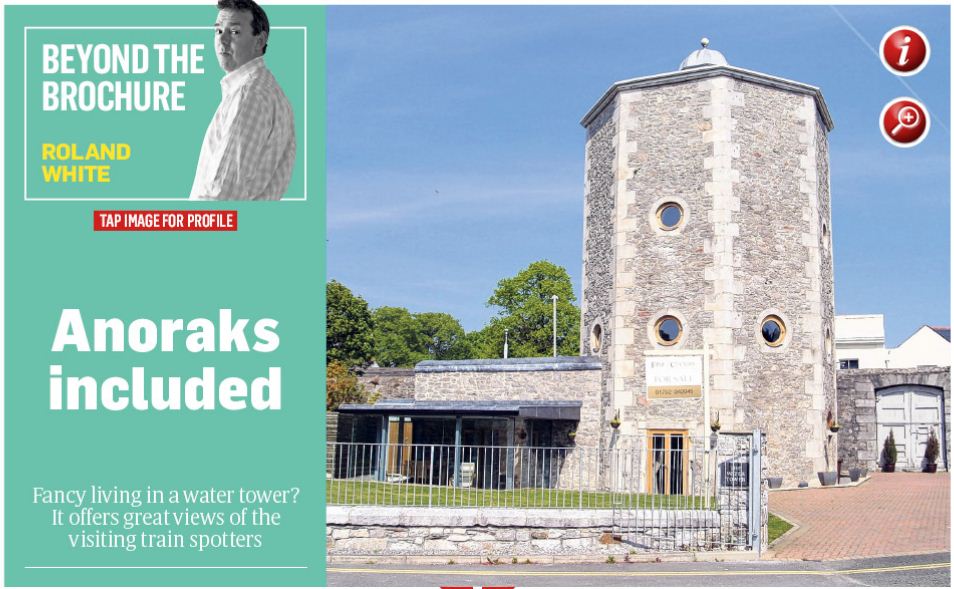
The converted Water Tower in the Millfields Hospital development in Plymouth is for sale in the region of £400K. As the editor and a founder member, I am really honoured that this blog and BWTAS members were mentioned by "Atticus" himself, Roland White, in the Sunday Times profile of the property, even though it tried too hard to make BWTAS the butt of a tired joke; riffing that potential owners might be visited by hordes of water tower "anoraks".

Erstwhile hosts know that our members don't show up uninvited and actually tend to be the corduroy sort of academics, artists, photographers and civil engineers (if I recall the most active members) and that we really don't mind being depicted as "nerds" because, truth be told, that has served to publicise the society. I suppose we'd better stock up on more merchandise for those Sunday Times readers now.

We'd be honoured to be invited in by the owners of the Millfields tower for a picnic as  Mr White suggested. Though members are generally more curious about anything in original condition, some members are architects interested in the challenges of tower conversion. We have copious evidence that any sort of accessible tower attracts visitors so it's true a hazard of tower ownership can be public attention, though that is exactly what is valued by some owners. An added benefit of purchasing this tower should have been mentioned by the Sunday Times; that all owners of water towers get complimentary membership of BWTAS.


Friday, 15 April 2011

Membership Map

We've been playing with the nifty tool Batchgeo.com and if anyone's interested, this is what we get when we drop the BWTAS membership list into the website with a couple of clicks. We have 22 addresses it didn't understand and I didn't include those in Cornwall, USA and Canada and Germany on the crop of the map.


Yes, you can drop in other geo data so you could map all the water towers you know of.


Thursday, 14 April 2011

Ahh, that's Bass! Relief as development permission granted for Sleaford Maltings


BWTAS member David Blackburn reports:

Planning permission was granted yesterday for a major redevelopment that should secure the future intact of the former Bass Maltings site at Sleaford, Lincolnshire.

This massive 13 acre listed Grade 2* complex comprises many brick buildings rising up six storeys There is a fine water tower almost hidden within. Last used as a poultry factory, but derelict for many years, it's over 50 years since it last produced malt for the brewing industry. There have been several failed restoration and redevelopment schemes and the site has decayed badly but it now looks as though the complex has a future. A new scheme by developer Gladedale proposes shops, office space and 220 houses and apartments . Hopefully there will be a restored - and accessible - water tower as a centrepiece.


According to the BBCNorth Kesteven District Council said it hoped the project would create 500 jobs and bring millions in investment.English Heritage had classified the Maltings as the largest at risk building in England. 


The organisation worked with the developer to protect as much of the original structure as possible. Simon Cocks from developer Gladedale Estates said: "We are not altering the external elevations at all. "There will be some internal demolitions but that is mostly taking down the fire damaged sections." The council's Economic Development Manager, Alan Gray, emphasised the importance of the project. "The Maltings scheme is an integral part of the wider Sleaford South East Regeneration project which has schemes which, when taken together, represent the biggest and most economically-significant commercial investments Sleaford has seen since the opening of the Navigation more than 200 years ago."


It is expected work will get under way in the autumn.
A commendable amount of detail of the proposals and history is at the developer's website which says:


The former Bass Maltings were completed in 1907 and were in use for their original purpose until 1959. Ten years later, the first fire occurred and then the Site was purchased by G W Padley for chicken rearing and vegetable
processing and freezing. There was a serious fire in 1976 and, in 1982,
Padley’s applied for consent to demolish all of the buildings. Their application
was refused and their subsequent appeal was rejected and the listing of the
buildings was upgraded to II*. In the 1990s, poultry farming ceased due to
health and safety reasons. There was a third fire in 1999 and in 2006 the
Site was purchased by Gladedale, the current developers.

The fact that so much of the buildings stand intact is testimony to the high
standard of the original build. The total fire-damaged area amounts to
approximately 25% of the total built space. The extent of damage is uneven
across the Site and five of the nine blocks remain undamaged by fire. Most of
the buildings have been altered to some extent, whether through fire
damage or physical change relating to later uses. The Site has been subject
to some vandalism and the upper parts of the buildings suffer from pigeon
infestation. 
Apart from the fire-damaged areas, the buildings are generally in good condition. The brickwork is mostly sound as are the floors, except in the kilns where they are missing. Roof structures are generally intact were away from the fire-damaged areas. Some fixed machinery remains in situ but almost all moveable machinery has been removed. Blocks 1 and 2 retain the most complete collection of surviving machinery and equipment.


Paint the water tower? Don't be Daffs...


Lifted with apologies from Wales Online.


The old water tower at Cardiff Central station could become the ultimate canvas for an acclaimed Barry-born artist Dan Llywelyn Hall (twitter @danllywelynhall).


The former Sunday Times Young Artist of the Year has submitted plans to transform the Grade II-listed structure into a colourful mural. He says the epic work – titled The Full Stop – will be a celebration of pivotal moments in Welsh history.


The 30-year-old has been in talks with Arriva Trains Wales, which leases the station from Network Rail, and this week submitted a planning application 10/02208/DCI to Cardiff council.


Mr Hall told the South Wales Echo he was excited by the prospect of the artwork welcoming thousands of rail passengers into the capital each day. “For most my life I have seen the water tower as a prominent structure in our capital,” he said. “Any time I would arrive into Cardiff it almost denotes the start of the city – like a garrison. It stands on the edge of the river and is the first building I notice every time I arrive into Cardiff and usually the last thing I observe when I leave. It struck me that this beautiful listed building needed rejuvenation and could be transformed into a positive confident statement about our capital.”


It is thought the abandoned tower is about 80 years old and was used to replenish the water supplies of steam locomotive engines.


Different moments in history would be painted in the divided panels and the circular turret will amalgamate to form a celebration of the land.


A spokesman for Arriva said: “We have had notice of his intentions to revamp the water tower, but we have seen no designs and he was advised to seek further advice from Cardiff council.”


A council spokeswoman said its Development Control had this week started a consultation on the proposal. If approved, monuments body Cadw, which has the right to call in applications on listed buildings, will then have the final say.


Mr Hall hopes to start painting in the early summer and expects it will take up to two months to complete.


Talks have begun with arts organisations and individual donors about sponsoring the project. Mr Hall, who recently had an exhibition at Cardiff’s National Museum of Wales and painted portraits of World War I veterans Harry Patch and Henry Allingham, said the work would be a gift to Cardiff.


“It’s for the people who come into Cardiff each day. I want it to promote our city and our country,” he said. “There is nothing that is symbolic or celebratory of our city and I hope it will give people a lift when they arrive in Wales.”


When BWTAS visited the tower in 2010, it wasn't exactly attractive or exciting. A previous mural of daffodils, Wales' national flower had weathered and faded.


Comments from the public show the strength of feeling water towers evoke:


"It is ridiculous to have this as a Grade 2 listed building. The thing should have been pulled down. It is an eyesore, whether painted or not."


(These) structures should be preserved for history - history needs to take account of the mundane as well as the extraordinary.


This is a marvelous opportunity to revive a very important structure in the heritage of our country. It will be most welcome to all the communters and passers by. My old man worked on the railway and always maintained the water tower was one of the finest examples in europe. Cardiff has more to it than simply erecting flats at every corner. We need to maintain our heritage and keep our artists in support.


It's about time something was done with the tower its had faded daffs on it for years now, I'm looking forward to seeing this when it done, I think it will look fab.


Wednesday, 13 April 2011

War over Warrington

Lifted from several stories in the Warrington Guardian with apologies:


The future of the historic 1906 Garnett’s Water Tower is likely to be decided tomorrow, Thursday, 14th April 2011.


Developers PTS Property have submitted a plan to Warrington Borough Council to demolish the  attractive Italianate crenellated tower and surrounding buildings and replace it with a temporary car park.


But objectors say the building is crucial to the heritage of the town centre.


Councillors will discuss the plans at a meeting of the development control committee in the Town Hall on Thursday. The meeting starts at 6.30pm


Preservation campaigners will learn then if their last-ditch bid to stop the demolition of the town centre landmark is successful.


Garnett’s Cabinet Works is between Cairo Street and Barbauld Street. Inscriptions on the tower say the company was founded in 1824 but the tower and factory was built in 1906.  According to Geograph: the factory's founder Robert Garnett was born in 1830 in Penketh, Warrington. He was a generous local benefactor to many churches and charities and even laid the foundation stone at Penketh methodist church.


The water tower connected to the building would be pulled down as part of plans for the derelict site. The developers say that redevelopment would not be economically viable due to the poor conditions of the building and others on the site and it is a hazardous in its present condition.


Now English Heritage has put its weight behind campaigners fighting to save it. It has called for the withdrawal of the plan for the tower, which is listed locally under the Bridge Street Conservation area.


Anna Boxer, historic buildings inspector for English Heritage, told Warrington Borough Council in its submission: “Once a heritage asset is lost it cannot be replaced and the loss has a cultural, environmental, economic and social impact. “Any loss within the conservation area should have a clear and convincing justification.”


The letter goes on to observe there is no indication of what is planned for the redevelopment of the site long-term. Mrs Boxer added: “The applicant is correct in saying that replacement of a demolished building with a similar one should not make part of the justification.


“An empty site is however not an enhancement of the conservation area, and especially not when the proposal is the loss of a principal building which would be categorised as substantial harm that potentially threatens the very basis of the designation.”


One of the residents hoping to halt the plans to demolish the water tower is Lymm resident Susan Gabathuler, aged 74. She said: “I’m very upset to think they might be doing that. It’s the history of Warrington and it needs to be preserved. They have a duty to keep these places open if it’s in a conservation area.”


John Rowlinson, managing director of PTS Property, said: “Victoria Works are constantly being broken into, despite efforts by ourselves and the police. Due to safety reasons, the poor state of the building and the fact the refurbishment is not economically viable and after consultation with the police, fire service, town wardens and the planning department, we feel we have no other option but to demolish the building... Hopefully, in time, it will help spark a regeneration of this area.”


Other residents have spoken out against the plans that will also see the council offices and the Cairo Street Sunday School room, based by Cairo Street, being demolished too.


Gill Hoff, of Bridgewater Avenue, Latchford, is one of those who is opposing the plans. The 31-year-old said: “They are very important historically and Garnett’s Water Tower is a very important part of the skyline. “This is the cultural quarter, this is supposed to be a very beautiful historic place.”


The owners of the site had taken on the Victoria Works and building in 2005 and added the Cairo Street Sunday School and council offices to its stable in 2007.


After gaining planning permission for the redevelopment of the site into retail, leisure and office space since 2006 the developers PTS have been unable to find any companies interested in taking on the property.


And since taking over they have spent in excess of £50,000 on maintenance and security for the sites, which have been plagued by a lead thief, drug addicts using it as a den and a free running group called Wolf Pack using the site.


Has anyone pointed out that's just what the area needs; a materials recycling scheme, a drug treatment centre and a gymnasium could be the key to area regeneration? 
And any reader of this site will see that other developers have tried to preserve water towers on their site because there's no better landmark or billboard for a place than its water tower. Ed.


images: Warrington Guardian, Geograph

Tuesday, 12 April 2011

Potsdam Wasserturm Bistro


The water tower at the main railway station of Potsdam, Germany is all that remains of what was Germany's largest reichsbahnausbesserungswerk (railroad repair workshops) or just abbreviated as R.A.W.

It was built in 1838 with the construction of the railway line between Berlin and Potsdam. The R.A.W. was the first German railway repair shop and over the years developed into one of the largest companies in Potsdam with the founding of the German Reich in 1871.

Potsdam 1930
After WWII, the repair workshops closed and were abandoned to decay. The construction of the new central train station began in 1997 when the old roundhouse was demolished but the old water tower, as well as some historical operating warehouses were protected and rebuilt. In 2007 redevelopment of the former RAW site started in earnest. The remaining buildings were renovated along with the historic train station and the water tower was converted into a café and bistro.


Wasserturm Cafe Bistro

Friedrich-Engels-Str. 99
14473 Potsdam
Tel.: (0331) 2011


Thanks to BWTAS member David Blackburn for sending this in. Though German WT seem to be all the rage on the blog at the moment, it's just because they can be like buses too.