Latest Tweet

Tuesday, 22 May 2012

The Water Tank Project

Word Above the Street is staging a large scale public art initiative to draw attention to water as a precious resource by transforming 300 of New York's celebrated rooftop water tanks into works of art.

Artists, musicians and scientists and New York City residents will redefine the skyline across all five New York City boroughs during Summer 2013.

The event aims to reach millions around the world through social networking, and online multimedia tools with a mission to harness the power of art and technology to build a better world, make art that makes a difference and broadcast art to an ever expanding audience.


You can download a snazzy PDF brochure about it.

Friday, 18 May 2012

Eins, Zwei, Dry...


Kerry and Chris Hones are a British couple who possess a trio of extraordinary water towers situated in Nennig on the border of Luxembourg and Germany built around 1870. They found them as a complete ruin and have spent many years renovating them, keeping as many original features as possible, including a shaft into something that looked like a strong room which has become the cat flap. They admit they are nowhere near finished with the project but do what they can when they can.


Nennig sits right in the corner of Luxembourg, Germany and France and the Moselle area is stunning. BWTAS members visiting Luxembourg are invited to come and take a look. Kerry says the wine tasting is to be recommended!


They tell us they have had their share of successes and mistakes along the way but "it is such an individual project we have had to learn as we go." By contacting BWTAS they hope someone will come up with some interesting information about the tower as all the local archives were destroyed in 1945 during WWII. One of the towers looks very similar to the Settle renovation tower though theirs have been added to  over the years and one is now three stories high. Kerry says with justified satisfaction; "It has been a labour of love, immensely hard work and has involved doing many kinds of work I would never of dreamed I could do. He reflects that "too much Kevin McCloud can get you into all sorts of unexpected projects. We have become known locally as the Mad English Couple!"


If you can help, please get in touch with them at khones@pt.lu


Túir uisce na hÉireann*


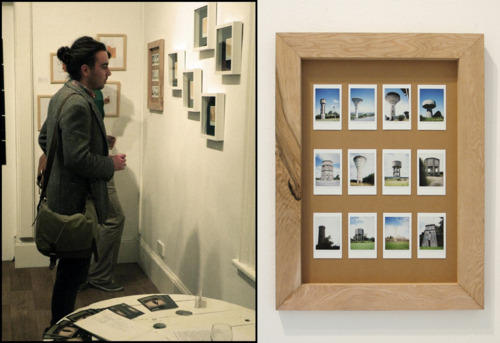
Water Towers of Ireland has been around since June 2010. Its curator/artist Jamie Young has regularly corresponded with BWTAS and says his purpose is to "draw people closer to these objects which seem to permanently sit on the horizon". His project is "part inventory, part photographic essay and part history..."

Jamie found water towers "could indicate a timeline in the history of the country - from the oldest water towers of railway stations, through the progression of concrete construction, and on to the need for larger reservoirs in recent times, when communities have simply outgrown their elevated supply..." 

He finds that "once these images are placed in front of an audience they themselves start to notice and value the water towers they encounter..."

BWTAS totally and utterly concurs. Like us, Jamie is looking for funds to publish his research. If there's a publisher - such as Taschen - who wished to combine the water towers of the UK and Ireland into one book, I am sure BWTAS contributors would be more than willing to oblige.


*apologies if the Gaelic is wrong, can you supply better?


Thursday, 26 April 2012

Tiger Hunt in Harrogate

http://www.flickr.com/photos/muddy-landrover/5248501927/ 

Tiger Aspect, producers of Channel 4 television's Restoration Man are looking into the historic background of the water tower on Drury Lane in Pannal, North Yorkshire and are not having much luck with finding out its history.

Their interest is piqued by a planning application to convert the tower to a dwelling, providing 4 bedrooms over 3 floors and a ground floor mezzanine with windows inserted in existing recesses in the south elevation and a ground floor window to the west elevation.

Any knowledge from BWTAS members or readers would be gratefully received by researcher Dionne Farley. Please contact her at:
Tiger Aspect Productions Limited
4th Floor, Shepherds Building Central, London W14 0EE 
0207 529 9496

Wednesday, 8 February 2012

Settle Station Water Tower Restoration Complete !

The tower taken in today's winter sunshine

The subject of "Restoration Man", Channel 4, 9pm Thursday, 16th February

Mark & Pat Rand, have completed the restoration and conversion of their 1876, grade II listed Water Tower. The project to convert and restore the only surviving water tower on the Settle-Carlisle line has been recorded by Channel 4's, soon to be broadcast, "Restoration Man". But for the full story, visit the Blog: settlestationwatertower.blogspot.com. Now restored to ‘as built’ by the Midland Railway, Mark says "the tower looks as though it could be a new-build, not built in 1876! No re-pointing and minimal pressure washing only in parts". A job well done - they deserve their black book and glass of lemonade on the roof!

The tower before work commenced

Ferrers


Tuesday, 31 January 2012

Amlwch, Anglesea, Wales (1953)

image courtesy of David Blackburn
The third of a trio of idustrial water towers is this 100,000 gallon tower, built in 1953 as part of a bromine and dibromoethane production plant. The water tower stored fresh water for process work, from local sources. The tower comprises two concentric cylindrical tanks, of 33ft 6in and 23ft 8in diameter respectively, arranged around the 5ft in diameter service shaft that extends below the tank and provides its sole means of elevation. The plants was owned by “The Associated Ethyl Company Limited”. In 1961 the name changed to “The Associated Octel Company limited”. The factory closed in 2005 and has since been purchased by the American energy company “Canatxx” who have plans to convert it into a LNG terminal for gas brought by tanker from the Middle East. The water tower is located at SH 44502 93547.
Dibromoethane was very effective in preventing the build up of lead inside engines, when Tetraethyl lead is added to petrol to prevent pre-ignition. In the late 1990’s the Amlwch site was taken over by “Great Lakes Chemicals limited”. The site moved away from producing DBE for petrol into producing Bromine and Bromine intermediates for use in a wide range of consumer products such as Pharmaceuticals, Dyes, Flame retardant, agrochemicals and water purification systems.
Ferrers

Monday, 30 January 2012

Garrett’s, Leiston, Suffolk (c. 1850)


This water tower, we are told, was built in the 1850's to provide water for the various chemical treatments involved in the steam boiler manufacturing process on the Garrett Works. The first evidence of the water tower is an engraving of the Garrett works, circa 1860. The engine house immediately to the North of the tower and depicted on the engraving along with its large chimney, was demolished in 1914. The Works’ Well located beneath the tower (some 487ft deep), also provided water for the town until 1910, when another well was sunk on the outskirts of town. Frank Garrett’s house in Aldringham was supplied with water from the works by cast iron pipes, although Leiston had no mains water supply until 1914. The water tower was restored between November 2001 and March 2002 and now forms part of the Long Shop Museum. As part of the restoration project, a second internal tank was removed.

The water tower was Grade II listed on 2nd August 1983 (IoE #401764). The water tower is located at TM 44407 62597.

Ferrers

Sunday, 29 January 2012

Bowling Green Mills, Bingley, West Yorkshire (1871)


BWTAS member, David Blackburn, sent us the above photograph, of an industrial water tower, as we don’t feature many of these. To rectify this, I’ll post a trio of industrial towers this month. The first being this one at the UK headquarters of Damart, the thermal clothing manufacturer. "Bowling Green Mills", as it was called, was built in 1871 for the production of Worsted. From the image on Google Earth, looking down the Damart chimney, the tank appears to be open topped and no longer in use - originally it had a pitched roof. David said that "it looks as if the height of the tower has been raised once or twice" the different coloured brick work beneath the tank suggests this and an image of Bingley taken in 1894, confirms that the tank was at a lower level when compared to a 2009 picture taken from a similar angle. Between the tower and the fine chimney, is the engine house. A nice detail is the gable end that has a centrifugal "flyball" governor in relief. The chimney and engine house are Grade II listed (IoE #337966). The water tower is located at SE 10765 39410.

Ferrers

Friday, 27 January 2012

Soup Tower chairman reflects on icon of Kings Lynn


Lynn: Tower loss is a blasted waste


CAMPBELL'S SOUPS TOWER A trip down memory lane Raymond Monbiot sifts through photographic memories of his time as UK chairman of Campbell's Soups. On the right of the picture is the Ogilvy Award which was won by the King's Lynn UK factory in 1984-85. The first time it was had been awarded to a factory outside the United States


Published on Thursday 26 January 2012 08:56


A former UK chairman and chief executive officer of Campbell’s Soups regards the destruction of the company’s iconic water tower at Lynn as a piece of town planning vandalism.


Raymond Monbiot, who still lives close to Lynn, ran the company for most of the 1980s though he was quick to emphasis his view was no criticism of Sarah Griffiths who was chosen to set off the charges that brought down the tower.


“They have removed an icon. The company did a lot for the town. They brought wealth and employment to King’s Lynn.”


He remembers when the tower was a flagship on the edge of The Fens. “When it was built in 1958 it was surrounded by green fields. Now it is surrounded by large stores and supermarkets.”


Campbell’s, a company with factories across the world, decided to site their first factory in Europe in the UK, some 3,000 miles from their head office in the United States. They chose King’s Lynn for their head-on battle for the British market against giants in the business like Heinz, Cross and Blackwell and Batchelor’s.


He said: “They came to King’s Lynn because of the clean air, clean water and the quality of the local produce.”


Monbiot was made UK chairman of Campbell’s in 1982 and later, in the mid-eighties, his responsibilities were increased when they opened a second factory in Salford in Lancashire. Such was the success of the two factories that the then Prime Minister, Margaret Thatcher, visited Salford to emphasise the importance to her government of the success of the American company’s entry into the British market.


During his time at the helm of the company there were 500 or so employers at Lynn.


Another important reason for choosing the town was that staff were ‘food friendly’.


“They came from an agricultural background and were well used to handling fresh produce.”


Many of the vegetables arrived at the factory with Fenland soil still clinging to them.


“In the factory there was always a wonderful smell of fresh food. We were a real quality food company,” he recalls.


But he also remembers the tight hold the parent company kept on its factories around the world.


He was inundated with books which detailed how to run the business.


“Even the pile of thick index books reached the ceiling. I never read them!”


Monbiot believes he was Campbell’s first British chairman and he used his long experience in the food industry to make sure their venture into the UK was success.


This was largely founded on their condensed soups which a survey discovered were used by eight out of 10 customers as sauces in their cooking, rather than purely as soups.


Emphasising this use was an innovation that helped increase the company’s share of the UK market from six per cent to 17 per cent and had the twin benefit of winning Lynn the company’s Ogilvy Award for success in 1984-85, the first time it had been presented to a factory outside the United States.


This success also meant that Monbiot had more autonomy that most chairman around the world.


“I was tactful but I was determined to run the business my way.”


But the destruction of the water tower marks the sad end to a company Monbiot believes did so much for Lynn.


Its height and size ensured that there was a constant and secure supply of clean water at the right pressure which was used copiously in all stages of the food process including being steam-heated to sterilize everything.


The destruction of the tower removes the last significant landmark of a local company that is a worldwide household name.


“Attempts were made to make the tower a listed building but they failed – I think by the Civic Society. I’m very sorry to see it go”


Now he has are only photographic memories of a company that was once the beating heart of the Lynn food industry


Lifted with apologies from Lynn News for preservation http://www.lynnnews.co.uk/news/environment/lynn_tower_loss_is_a_blasted_waste_1_3449419

Thursday, 22 December 2011

New application for conversion of Aldeburgh Park Road water tower

Suffolk Coastal District Council have posted notices that two new applications C/11/2792 and C/11/2991 have been received for conversion of the water tower at Park Road IP15 5ET where previous applications (references C/10/3260 and C/10/3261) were refused.


The architects believe the new scheme meets the concerns raised by the council and the members of the public with regard to the previous design.


BWTAS won't take sides on planning issues but it does note that the more thorough historical investigation of the tower that was submitted with this application shows that judgements of 'historic significance' and 'architectural merit' are relative and made according to the information available. We're grateful that the tower does have more historic significance than was first suspected with its connection to the transit system of Brooklyn, USA and the colourful William Fontaine Bruff, an emigrant from Essex to that city who made a fortune there in railways, one was called 'Bruff's Road', who was also the designer of the Aldeburgh tower.