Latest Tweet

Friday, 15 June 2012

Brooklyn sculpture is fantastic plastic water tower


image from Junk Culture

The BBC reports a Brooklyn-based artist Tom Fruin has used 1,000 pieces of transparent plastic scavenged from various parts of New York to create a sculpture of a water tower.

The artwork is open to the public and can be seen from the Brooklyn and Manhattan bridges and from parts of lower Manhattan.


It is illuminated by the sun during the day and by Ardunio-controlled light sequences designed by Ryan Holsopple at night. It opened on June 7th and will be in place for one year with a light show beginning at dusk and continuing to morning.

Tom Santorelli reports

Inside the sculptor's workshop:


We know it's a load of scrap but is it art? Of course it is.

Sunday, 3 June 2012

Castlethorpe Troughs Water Tower


There's a nice detailed site on the railway at Castlethorpe and the Wolverton Works near Milton Keynes.  http://www.mkheritage.co.uk/cv/docs/railway/railmain.html 

The London to Birmingham railway was opened in 1838. It passed near to the village of Castlethorpe cutting the outer earthworks of an 11th century castle from which it got its name. Castlethorpe station opened in 1882 and south of it were laid water troughs that steam locomotives on the West Coast Main Line could pass over to refill at speed. A scoop was lowered from the engine and this had to be timed very precisely in fog or in the dark. This stretch appears to have a high incidence of accidents either involving workmen on the track or mechanical failures at speed. Castlethorpe station was closed in 1964 despite protests organised by a prospective Labour MP named Robert Maxwell.


http://www.mkheritage.co.uk/cv/docs/railway/watertower.html
The Gas Works at Wolverton were reponsible for the maintenance of Castlethorpe troughs and its pump. 


crop of copyright image: click through  to view


crop of copyright image: click through to view


Milton Keynes Borough Council provide directions to a walk to all of these sights.


A British Transport film shows the A4 locomotive Sir Nigel Gresley in service as the Elizabethan Express picking up water. Sir Nigel is now preserved.


Saturday, 2 June 2012

They didn't just grow there

The recollections of an itinerant family of 'tankies' and their 284 water tower career in the postwar era.


download from 

Thursday, 31 May 2012

BWTAS Elveden Visit


A lucky few BWTAS members mustered outside the estate manager's office on Wednesday 12th October 2011 for a rare opportunity of a view inside the Elveden Estate's 1895 water tower. Set besides the magnificent hall, which is even more inaccessible to the public, this was a chance to examine one of the water tower crown jewels in its strong-room and velvet cushion of 23,000 acres of private estate. Whilst the interior rooms and architectural and engineering details were photographed, it was a condition of this visit that we didn't publish any of them.

The present owner of Elveden, the 4th Earl of Iveagh - Ned to his friends - is a descendant of the Guinness brewing family who inherited Elveden at the age of 21. The first house here was built in the 1760s by Admiral Keppel. But it was the Maharajah Duleep Singh who in the 1860s created a palace to pay homage to his Indian homeland and satisfy his passion for shooting. The maharajah's house was designed by John Norton. Singh had been deposed from the Punjab by the British and he gave, he said forever afterwards it was swindled from him, the Koh-i-Noor diamond, as collateral for the Sikh War. In recompense, Singh was granted a pension and he bought Elveden in 1863.

Duleep Singh left England in 1886 and died in Paris in 1893. Elveden was sold to meet his debts and it was bought by the 1st Earl of Iveagh in 1896. The vibrant colours in the hall were later whitewashed over as he used his Guinness fortune to remodel the hall and the estate. Father and son architects William and Clyde Young were commissioned to double the size of the hall, and Caspar Purdon Clarke – the director of the Victoria and Albert Museum and an expert in Indian decoration – designed the Indian Hall to link the old and the new.


At the same time, the First Earl modernized the estate, building servant blocks, laying out gardens and building the water tower and stable complex. The Elveden shooting parties were legendary and graced by royalty. After he died in Paris, on the orders of the Indian Office, Duleep Singh was buried next to his wife and son in the Elveden churchyard, now a place of pilgrimage for Sikhs.


The estate manager taking us round informed us the tower was built to both supply the estate grounds and the village; this is confirmed by its size. The homes that still receive water from the tower do so free of charge to this day. It was not deemed safe to go into the cupola over the tank but there is a ladder to reach it if you are agile enough to duck under the tank and prepared to encounter bird droppings. The square main tank is as usual constructed of flanged iron panels, bolted and bitumen sealed and has two compartments divided down the centre. Supporting ironwork (and no reason not to think the tank as well) was produced by Dorman Long of Middlesbrough who also built the Sydney Harbour Bridge.

Beneath the tank room is a large room finished with architraves and mouldings as a drawing room with large sash windows framing views in each direction with balconies with now fragile balustrades. This delightful space has been used for shoot lunches and a lucky bride’s wedding reception. Beneath this room is a double height room of bare masonry sitting mid-way up the tower which contains a substantial chain hoist affixed beside stable doors opening to the outside. Without any evidence of machinery apparent, it would indicate that the room’s purpose is some kind of stores. During WWII the contents of the Iveagh Bequest at Kenwood House was moved to Elveden. Contemporary reports say the priceless paintings by Vermeer, Gainsborough and Landseer were moved into the basement of the hall but evidently some were also stored in the cool dark of the water tower. Surprisingly, very few water towers in the UK suffered from enemy action; their usefulness for enemy navigation outweighed the impact of directly attacking them.


The two floors below the stores level contains two apartments with Victorian wallpaper still extant. These rooms are above the ground floor pump room (or a former pump room) which was inaccessible by virtue of our guide not having the right keys. The first five levels are all accessed by a windowed internal stairway of stone steps. Beside the tower there are some outbuildings forming a courtyard which were apparently a workshop, foundry and fuel store for the pumps. The chain hoist to the storeroom floor (corresponding with the ashlar bands on the exterior) would have been loaded from here.

The borehole that supplies this tower is 1.2 miles to the south, where a pump house and Braithwaite style water tower is located now at TL 82302 77685. We could not determine if that is the original borehole but it seems unlikely. Boreholes can dry up and it’s easier to move a borehole than a tower.

The tower is still used to distribute water by electric pumps located within the tower but the tanks are no longer used to provide storage and head. The tanks were decommissioned sometime in the last ten years due to algae being found in the water.

There was speculation in the party that the tower could be built of Elveden bricks, but we found the Elveden brick works producing the distinctively stamped red bricks that are used in the construction of the estate cottages was established in 1901, after the tower was constructed.


While the hall has been seen on the silver screen in a starring role in Kubrick's Eyes Wide Shut and the action adventure Tomb Raider and the Bond movie The Living Daylights; the tower, not to be outdone, also has had a brief career on the idiot's lantern. The tower was the objective of the rival platoons during a war game in the classic BBC comedy Dad's Army in its Christmas Special: The Battle of the Giants.


National Register
TL 87 NW ELVEDEN ELVEDEN PARK 2/18 Water tower, 200 metres - south west of Elveden Hall - II* Water-tower, 1895 on plaque. About 20 metres high, square on plan. Eclectic in style, but with mainly Baroque details. Red brick, with limestone dressings at the upper levels. Battered base and 4 further stages, of which the 4th is dominant. The 3rd stage has flush horizontal bands of limestone ashlar, and the 4th stage has dressings strongly expressed in limestone. Windows in the Baroque manner; limestone architraves with keystones and moulded cornices. At the 4th stage is a large central window on each face, with a balustraded balcony on stone brackets; flanking flat pilasters support a moulded cornice and arcaded parapets with central Flemish gables. The doorway at the base has a semi-circular brick arch of several orders, with deeply recessed framed and boarded doors. Copper-covered cupola roof with weather-vane finial. Included as Grade II* because an exceptionally elaborate and imposing example of a Victorian estate water-tower.
The estate has over 10,000 acres under cultivation producing great quantities of grain, onions and potatoes. It is said that a quarter of Walkers' Crisps come from here and many of McDonalds’ potatoes and carrots. Other Elveden businesses include Christmas trees and team of six gamekeepers for looking after shoots and encouraging wildlife such as the stone curlews who nest in the onion fields.

The hall is opened rarely, usually for NSPCC balls and for events for the causes the Iveaghs support. The restoration is slow and painstaking and is being done without public grants.

The American Air Force requisitioned the hall in World War II to use as a headquarters – their stencilled office numbers and directions are still visible on the doors of some buildings. Other evidence of wartime ‘occupation’ is perhaps more unusual and interesting. On the estate (location withheld for their protection) is a grove of mature beech trees which contain WWII arborglyphs. These poignant reminders can also be found in the woods on Salisbury Plain and have been the subject of doctoral study. The most visible is the name (indistinct) Schultz Hollywood Calif April 20 1944. Naturally with many thousands of young men and women billeted at Elveden in wartime, some would choose to leave behind a permanent mark in case they never came back. 


Archaeologists of modern history are starting to study these arborglyphs more intensely because they can give a wide range of information about the individual who created them and their environment. This has led to a discussion about the importance arborglyphs are in both a military and non-military context. Arborglyphs are carvings that record poetry, names, dates and places, creating a record of human interaction with the landscape. Therefore military arborglyphs can reveal much about modern man in warfare from the material culture he leaves behind. 


Enquiries in California by BWTAS have determined that there were 44 males named Schultz living in Hollywood of military age in 1941 and it’s likely there are descendants or relatives still living there but it is not possible to narrow that down without access to US military records.


CAMP BLAINEY, E1veden Hall, Suffolk
RAF Station No: 116
Location: Four miles southwest of Thetford on A11
3d Bombardment Division (BAF), 13 Sep 43 to 27 Oct 45. Moved to Hanington, Oct 45. Re designated 3d Air Division, Dec 44.
Wings: 65th, 66th, 67th Fighter; 4th, 13th, 14th, 20th, 45th, 92d, 93d Bombardment
4th Bombardment Wing (8AF), Jun to 13 Sep 43. Moved from Marks Hall; moved to Bury St Edmunds, Sep 43.
Groups: 94th, 95th, 96th, lOOth, 385th, 388th, 390th, 447th
13th Bombardment Wing (8AF), 13 Jun to 13 Sep 43. Moved from Marks Hall; moved to Horham, Sep 43.
Groups assigned Sep 43
92d Bombardment Wing (8AF), 12 Dec 43 to 2 Mar 44. Moved from Polebrook; moved to Sudbury,
Mar 44.
Groups: 351st, 401st, 486th, 487th
For the visitor interested in military history, nearby is the Elveden Memorial, a grand 113-foot Corinthian column designed by Clyde Young and erected in 1921 and dedicated to the memory of local soldiers from the three parishes of Elveden, Eriswell and Icklingham who died in action in the First World War. Their names are inscribed on the base and a shorter list was added after the Second World War. Inside 148 steps lead to the top which is crowned by a mighty stone urn. Accessibility to the inside is unknown.


The future for the tower looks promising but by no means is assured. There is enormous potential in it. The Elveden Estate is passed by millions of vehicles annually travelling along the A11 which after years of consultation and deferment will eventually become a dual carriageway. Nearby are the attractions of Thetford Forest and Centre Parcs. The Elveden Estate run a range of quality shops and a coffee shop and restaurant stocked with their own produce that will rejuvenate the visitor. It is a short walk across the road from them to the church but the tower itself stands on private property.


www.elveden.com


Wednesday, 30 May 2012

Ten Famous Belgians


There's a British pub-quiz perennial: name ten famous Belgians. Of course you lose a point if you name the fictional Hercule Poirot. What isn't fictional is that the tiny plucky country dispensed with government for over year and nobody revolted so evidently it is a very civilised place. It also has a wealth of water tower culture, something BWTAS posits is not unrelated.


Charleroi, Belgium 11/25/1990
Id: BW-6090-7-25.11.1990


Gallery of more Belgian industrial water towers

Near Antwerp is a stunning converted water tower house designed by architect Jo Crepain of Crepain Binst Architecture. The Moereels House is located in Brasschaat.


Chateau d’eau is a remarkable home made from a reclaimed water tower in the small town of Steenokkerzeel. 


Read more: Water Tower Transformed Into Minimalist Modern Home.

The water tower below is in Tienen in the Flemish part of Belgium and is by Architect Ortwin Deroo. It's 46 meters high with a viewing platform.


There are many more on this excellent gallery of Belgian Water Towers.

However, Mrs Benjamin of Suffolk sent BWTAS this week an image taken on her Eurostar city break to Bruge. It's located at 51.080935,3.114796


Mrs Benjamin wrote: Deze is voor je – de watertoren van Tourhout.  De waterbedriif is Vlaamse Maatschappij voor Watervoorziening.

(This is for you, the water tower of Tourhout. The water company is VMW)
Interestingly, this tower doesn't appear in the previous galleries so it seems there must be plenty of water towers in Belgium left to document. Happy hunting!

With a lack of information about Tourhout water towers, the only notable thing we found about Tourhout is that it produced Sylvie De Caluwe. OK, we were kind of distracted from searching much further but we hope she will one day earn a place on a list of very famous Belgians.


Score a point if you said:

Audrey Hepburn
Eddy Merckx
Adolphe Sax
Herge (George Remi)
Plastic Bertrand
Peter Paul Rubens
Rene Magritte
Leo Baekeland
Liz Claiborne

That's only nine? Oh, poor Belgium but we British think your water towers are more than enough compensation.


Tuesday, 29 May 2012

Indian Inspiration


Painting No. 130, Water Tower
Stewart Indian School, Carson City, Nevada
8"x 8", oil on linen panel
September 1, 2011

Standing over the facility, like a giant sci-fi robot, the water tower is surrounded by trees and buildings. It's silvery exterior reflecting the local color. This is painting 6 of 10 in a series painted at the school. 

Source: http://jamesamckewfineart.blogspot.co.uk/2011/09/water-tower.html


The Stewart Indian School in Carson City Nevada served as an off-reservation boarding school from 1890 through 1980, and its stone buildings are an icon of education and life for many American Indians in the West. After the school closed, the buildings were emptied and many became home to state offices. It is listed on the National Register of Historic Places and is comprised of 83 buildings.


Sunday, 27 May 2012

Some Lytes relief...

© Mr Michael Perry
Water tower disguised as dovecote. Circa 1907-1940 OS Map Ref ST 53438 26628

Lytes Cary is a manor house with associated chapel and gardens near Charlton Mackrell and Somerton in Somerset, England. The property is now owned by the National Trust, has parts dating to the 14th century, with other sections dating to the 15th, 16th, 18th, and 20th centuries. "Yet all parts blend to perfection with one another and with the gentle sunny landscape that surrounds them," comments Nikolaus Pevsner. The House is listed as Grade I by English Heritage. At the end of the formal 'Apostles' garden sits a dovecote which is in fact a disguised water tower built by the Jenners family in imitation of the dovecote at Avebury Manor as not to detract from the house.


Sir Walter Jenner (1860-1948) was the eldest son of Sir William Jenner, who was physician to Queen Victoria and, as a fashionable London consultant, had become very wealthy. Sir Walter bought Lytes Cary in a dilapidated state from the Dickinson’s of nearby Kingweston and began a major restoration. Perhaps inspired by the work of his brother, Leopold, who purchased Avebury Manor at much the same time, Sir Walter was a champion of the English Arts & Crafts movement and also collected appropriate antique furniture and tapestries to adorn the house and also did much in the garden and grounds. In 1940 he bequeathed the house and the 365 acre estate to the National Trust.

National Register
ST52NW CHARLTON MACKRELL CP ILCHESTER ROAD (East side) LYTES CARY 5/34 Dovecote about 120 metres north east of Lytes Cary - GV II Dovecote. Possibly C18. Local lias stone cut and squared; stone slate conical roof, with timber and stone roof upstand for birds; horse weathervane. Circular plan; plinth, four offset buttresses to near full height, eaves course: east side boarded and studded door and 3-light casement with ornate leaded-lights, both set in voussoired segmental arched openings. Interior not seen.

Dovecotes from Photographers Resource.

For centuries pigeons and doves were an important food source and were kept for their eggs, meat, dung and feathers. Their down and feathers were used to fill pillows and feather beds and a common superstition was that those who slept on pigeon feathers would live to a ripe old age. Their dung was also highly rated and had a number of uses, not only being used as a fertilizer, but was also used in the tanning industry to soften leather, and in the early 17th century it was a major source of salpetre used in the manufacture of gunpowder. However it was for their flesh and eggs, especially in winter when other meat was scarce, that they were particularly valued. In 1600 Oliver de Serres wrote in his book on agriculture that ‘no man need ever have an ill-provisioned house if there be but attached to it a dovecot, a warren and a fishpond wherein meat may be found as readily at hand as if it were stored in a larder.’

Water:Image Conference

House. Jerusalem by Per Bak Jensen for sale at Galleri Bo Bjerggaard
4th - 6th July 2012

A conference to celebrate the 10th year of summer symposia organised by Land/Water and the Visual Arts Plymouth University, UK Heidi Morstang, Jem Southam, Liz Wells.

Keynote speakers: Deborah Bright and Per Bak Jensen

Core Themes Place / Poetics / Politics / Materiality / What is water?

From salt water to holy water, there is a long history of art referencing water in its many dimensions, locations and states. Imagery may explore water as substance, make metaphoric allusion, or engage debates relating to the geographies and socio-politics of water. Artists may have deep personal relationships with particular waters, or more documentary concerns with water needs and uses.

Water means life. In an era of climate change, debates about water, its availability and significance range across a number of academic fields. This conference will focus on water in its many states and circumstances, wherever it flows, floods, freezes, stagnates or evaporates. It will bring together artists/academics in lens-based and related fields of enquiry internationally, offering inter-disciplinary opportunities to share research, whether practice-led, art historical, geographic, theoretical or curatorial.

Themes and questions include: -

. Practitioners responding to and representing material aspects of water as a substance capable of many states, from the frozen to steam and vapour?

. Water as related to ecology, process, boundaries, the liminal and the transitional, physical geography and environmental change?

. Cultural geographies and the politics of water and place?

. Psychological and phenomenological perceptions and expressivity.

. Narratives, histories, memories and journeys.

Land/Water consists of artists, writers and curators who embrace a diversity of creative and critical practices. As a research group it operates as a forum for interrogation of nature and culture, aesthetics and representation. Questioning imagery and practices relating to land, landscape and place is central to our ethos. As artists, writers, curators we work individually exploring space and place as a point of departure for experimenting in new modes of communication through picturing. We generate work that addresses a range of issues. These include environmental change, sustainability, journey, site and regional specificity.

Price includes the conference proceedings, conference pack, tea breaks, lunches and a wine reception on the 4th July.

MORE BOOKING INFO

Saturday, 26 May 2012

Herringswell Manor and Water Tower - update

Ballance family at play
When clearing out the BWTAS cupboard (alright, it was a hard drive) I came across some notes I had meant to use to update the prior posting for Herringswell Water Tower near Bury St. Edmunds in Suffolk.


Herringswell Manor is a large mock Tudor house built as a private home in 1901 on the site of the old manor. It was owned by Arthur Ballance [1851-1927] who made his fortune as the stockbroker Marnham & Co. while his wife's maiden name was Frean, as in Peek Frean biscuits. Their son Leslie Arthur was killed in the Somme in 1916.

Whilst by this time municipal water towers were commonplace in towns, in rural areas estates such as Benacre, Sandringham, Orwell Park, Kilverstone Hall, Elveden and Thornham Hall needed towers to supply the house and the home farm; typically from a borehole by a diesel or electric pump housed underneath. The upper stories and space below the tank could house staff or would be used for wine or root storage and in the case of Elveden; the priceless paintings from Kenwood House (the Iveagh Bequest) during WWII. Sometimes a room was created, naturally with a view, for game keepers to keep an eye out for poachers or to host shooting lunches. While the windows on the tank level might be dummy (we wish we could have a look inside) the cupola above and windows below the tank shows the Herringwell water tower follows this pattern. The shape of the tower is also reflected in the estate's gatehouse.

From about 1930 to 1948 Herringswell Manor was then owned by the Gosling family

Around 1948 the estate was sold to Miss Keyser of Aldermarston

In February 1956 R J Upton bought half the estate but not the manor house or the water tower.

In 1981 the manor and 14 acres was bought by followers of the Bhagwan Shree Rajneesh and 200 orange robed sannyasin lived there as the Ashram Medina.


These new residents raised the population requiring, for the first time, the establishment of a Parish Council. After the Baghwan died the commune was wound up in 1985.

Then the house was bought by the Shi Tennoji school, a Japanese Buddhist boarding school which closed in 2001 because of falling numbers.

The manor house and ancillary buildings have been converted into luxury apartments which became available for sale in the summer of 2006.

Around 1959 the other half of the Herringswell Manor Estate was bought by Mr Weston-Evans, including the water tower.

About 1960 Mr Weston-Evans renovated Herringswell Manor.

About 1961 the water tower was completely refurbished.

In 1965 R J Upton bought the rest of the Herringswell Estate including the manor and water tower.

In 1966 R J Upton realised that all the horse boxes were too small for the modern horse and decided to install a pig unit within the water tower complex instead. The water tower itself was closed off and not used except for the ground floor area.


On 16th October 1984 the Herringswell Water Tower was listed Grade II, NGR: TL7194170997

In 2008 a complete refurbishment and conversion to 2 to 3 bedroom dwellings was completed.
 

The present agents for the water tower are Upton Suffolk Farms, Herringswell IP28 6SR and the owner of the business is Hugo Upton.

Friday, 25 May 2012

Radar-cal revision of Allhallows Water Tower


images from Geograph

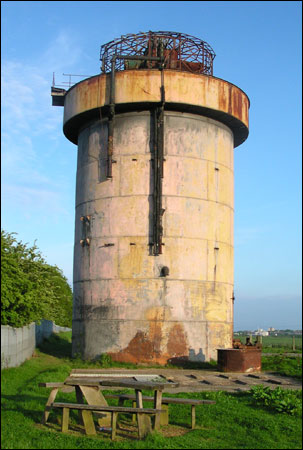
A former Braithwaite water tower near Allhallows, Medway, England once owned by Southern Water was converted in September 2008 into a radar station by the Port of London Authority to monitor ship movements on the Thames. The Yantlet Line which marks the downstream limit of the PLA area lies 4 km to the east.


This re-version is a variation of the Tilbury radar tower disguised during WWII as a water tower.

Information Britain says:

Allhallows is a village and civil parish on the Hoo Peninsula in Kent, under the unitary authority of Medway Council. The Hoo Peninsula is a jutt of land above Rochester, sandwiched between the Medway and the Thames and divided from the Isle of Grain by the Yantlett Creek. Allhallows village is in two parts: the ancient Hoo All Hallows and the 20th century holiday colony Allhallows-on-Sea. Hoo All Hallows is clustered round the parish church of All Saints. All Saints church dates from the 12th century and is the only Grade I listed building on the Hoo peninsula. The modern holiday village of Allhallows-on-Sea lies to the north of the village and was developed by Southern Railways in the 1930s. Their original planned development never took place because of World War II, but there is a now a Haven holiday park and some residential properties on the estuary shore. The station was demolished in 1961 and sold for use as a holiday caravan park. There is a listed railway water tower situated among the caravans. The area is popular with bird watchers. Other leisure activities include a 9 hole golf course and The Cross Park Country Park. There are a couple of pubs, The Rose and Crown Inn and The British Pilot.